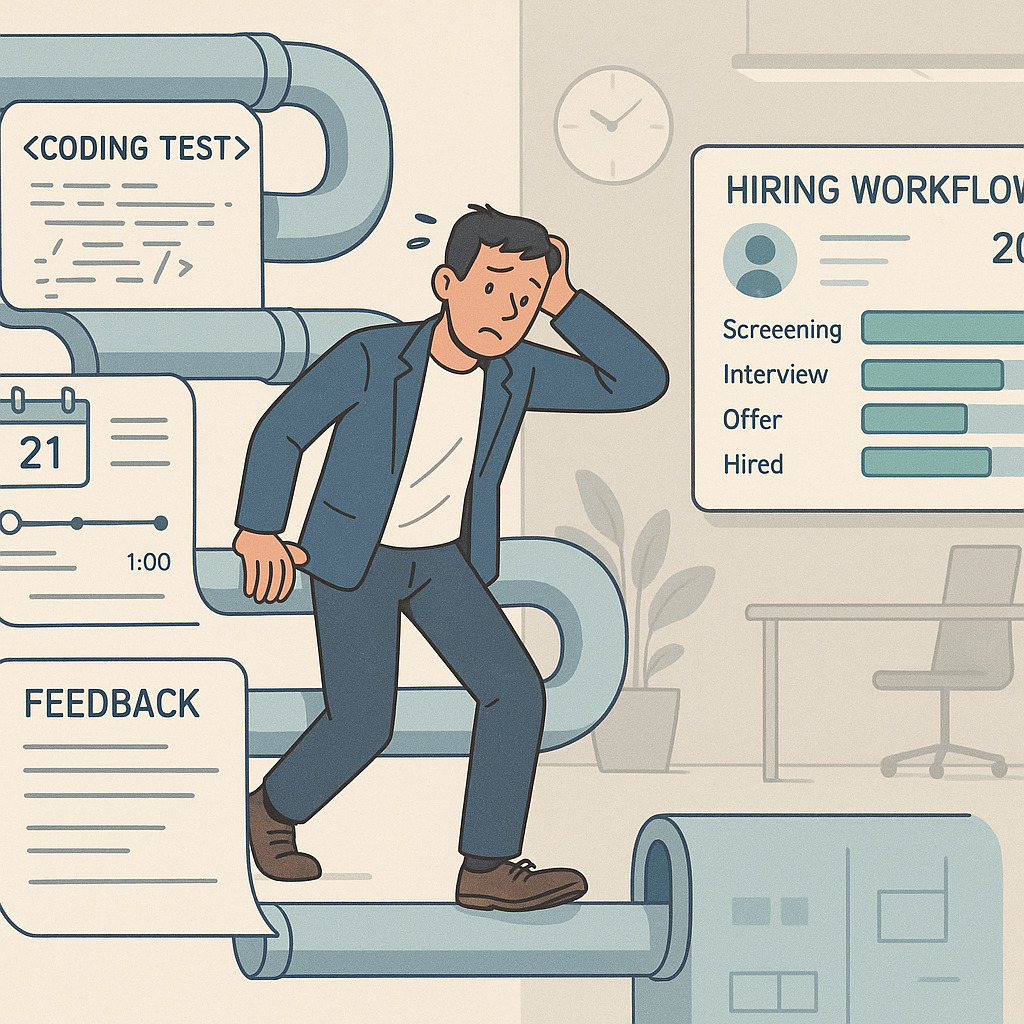
The tech job market in 2026 has made one thing hard to ignore: candidates are not just frustrated by rejection. They are frustrated by the process itself.
That distinction matters. A candidate can accept a hard interview, a competitive field, or even a no. What wears people down is a hiring loop that feels sloppy, inflated, or disrespectful. And when enough people describe the same problems in public, it stops looking like isolated bad luck and starts looking like a systems issue.
The technical interview process has become one of the clearest examples. In many companies, it now asks for more time, more unpaid prep, and more emotional energy than the role itself seems to justify. The result is a weaker candidate experience, slower decision-making, and a hiring brand that erodes in the places employers least control.
You can see that plainly in Reddit posts from job seekers speaking without PR polish or recruiter filters. In one thread on r/cscareerquestions, a developer described being unemployed since December and struggling to get traction in a market that already feels punishingly slow (source). In r/recruitinghell, another poster wrote about hitting a year and a half of unemployment, capturing the exhaustion that builds when every interview carries real financial and emotional weight (source).
Those stories are not evidence of every company doing everything wrong. But they are useful signals. They show how candidates experience hiring when the stakes are high and patience is already thin.
In that environment, a bloated or poorly run interview loop is not a small annoyance. It becomes part of the reason people stop trusting employers.
The problem is not difficulty. It is wasted effort.
A lot of hiring discussions get stuck in a false choice: either interviews are rigorous or they are candidate-friendly. That is not the real divide.
Candidates generally understand that technical hiring should involve evaluation. They expect to demonstrate judgment, communication, tradeoffs, and role-specific skills. What they resent is waste.
Waste looks like:
- duplicate rounds that test the same thing twice
- take-home projects that sprawl far beyond the job
- live coding sessions with contrived prompts
- interviews run by people who have not read the resume
- sudden scheduling changes framed as normal flexibility
- long silences that leave the candidate doing all the emotional bookkeeping
None of that makes hiring more selective in a useful way. It mostly signals that the company has not been disciplined about how it evaluates people.
That is why the current conversation around candidate experience is more than etiquette. It is operational. If a process is vague, repetitive, or disrespectful, it usually means the underlying hiring system is poorly designed.
What candidates are actually reacting to in 2026
Public hiring complaints are often dismissed as venting, but the details are revealing.
A post in r/recruitinghell described a finalist for a director role being asked to meet on a Saturday, which immediately raises questions about planning and boundaries rather than talent assessment (source). Another candidate described interviewers sighing and rolling their eyes during the interview itself, a vivid example of how quickly a process can slip from demanding to openly unprofessional (source).
Even adjacent discussions point to the same issue. In a thread about German tech companies allegedly punishing people who work efficiently, the deeper complaint was not just about work culture. It was about systems that reward optics, endurance, and conformity over practical output (source). Hiring often mirrors that logic. Candidates are not simply being measured on whether they can do the work; they are being measured on whether they can tolerate a ritual.
That is where the technical interview process starts to break down.
The issue is not that every candidate should breeze through. The issue is that too many processes no longer look tightly connected to the actual decision being made.
Four ways the technical interview process goes wrong
1. The loop gets longer than the hiring question requires
This is probably the most common failure.
One round becomes two. Two become five. Then a panel is added because one stakeholder wants more confidence. Then an executive chat appears at the end because it feels safer to include one more opinion. By that point, the process may be impressive on a flowchart, but that does not mean it is producing better decisions.
A good interview loop should answer a small number of concrete questions:
- Can this person do the job?
- Can they work well with the team?
- Do they show the level of judgment the role needs?
- Are there any meaningful risks we still need to resolve?
If a stage does not answer one of those questions, it should probably not exist.
2. Assessments drift away from real work
Candidates can usually tell when an exercise was designed for convenience rather than relevance.
A backend engineer may be asked to solve a puzzle that has little to do with the job. A senior hire may be given an architecture discussion so broad it rewards performance over clarity. A take-home may quietly become unpaid consulting work.
The problem is not only fairness. It is signal quality. If the exercise is detached from the role, the result is harder to trust.
That matters in developer hiring, where teams often claim to care about practical problem-solving but then rely on formats that measure speed under artificial constraints. There is room for different interview styles, but there should be a visible line between what the company says it values and what it actually tests.
3. Interviewer quality is treated as optional
Companies spend a lot of time talking about candidate quality and not nearly enough time talking about interviewer quality.
Yet interviewer variance is one of the biggest sources of noise in hiring.
Some interviewers are prepared, calibrated, and clear. Others improvise. Some understand the role. Others cling to favorite questions or personal preferences. Some know how to challenge candidates respectfully. Others confuse intimidation with rigor.
From the candidate side, this is obvious. They can tell when one person is following a shared rubric and another is winging it. They can tell when an interviewer is listening and when they are waiting to catch a mistake.
A bad candidate experience is often a symptom of this exact issue. The company does not have one interview process. It has a collection of individual styles loosely held together by calendar invites.
4. Communication is treated as secondary work
Silence, delay, and vagueness do real damage.
In a softer market, employers sometimes assume candidates will simply wait. Many do, because they have to. But that is not the same thing as a healthy process.
Candidates are often juggling multiple interviews, financial pressure, family expectations, and the accumulated stress of months without a stable outcome. A week of no updates does not feel neutral. It feels like another sign that the company does not know what it is doing.
Clear communication does not require long essays. It requires discipline:
- explain the stages in advance
- tell people who they are meeting and why
- set a realistic timeline
- update them when that timeline slips
- close the loop cleanly, even on a rejection
These are basic actions, but they shape trust more than many employers realize.
Why this feels worse in the current market
Part of the reason hiring complaints feel sharper in 2026 is that candidates are carrying more strain into the process.
Someone who has been unemployed for months is not entering an interview as a blank slate. They may have already spent dozens of hours on prep, presentations, coding tasks, networking outreach, and recruiter calls that led nowhere. They may have been ghosted, deprioritized, or told a role was paused after the final round.
That context changes how the technical interview process lands.
A surprise assignment does not feel like a normal request. It feels like one more extraction of unpaid labor.
A slow response does not feel like administrative lag. It feels like another week of uncertainty.
A dismissive interviewer does not feel like one awkward conversation. It confirms the candidate's fear that the process was never serious to begin with.
Hiring teams that ignore this context often misread candidate behavior. Caution gets mistaken for low enthusiasm. Detailed questions get mistaken for defensiveness. Fatigue gets mistaken for weak communication.
In reality, many candidates are responding rationally to a market that has trained them not to trust the process.
What better technical hiring actually looks like
Fixing the interview experience does not mean making every step easier. It means making every step legible.
A strong technical interview process usually has a few clear traits.
First, it is scoped. The company knows what each stage is for, and it does not add rounds casually.
Second, it is role-relevant. The assessment reflects the work closely enough that both sides can learn something useful.
Third, it is calibrated. Interviewers are not inventing the standard as they go.
Fourth, it is transparent. Candidates know what comes next and when to expect movement.
Fifth, it is respectful in the small ways that actually matter: punctuality, preparation, clarity, and tone.
This is not soft HR language. It is process design.
And in practice, better process often produces better evidence. When interviewers use shared criteria, hiring teams spend less time relitigating opinions. When notes are structured, decisions move faster. When the process is shorter and clearer, candidates show up better prepared and less defensive.
Where Nuvis fits
This is the practical opening for Nuvis.
The company does not need to claim that AI will magically fix hiring. Most people are rightly skeptical of broad AI promises, especially in recruiting. The stronger case is narrower and more believable: teams need better infrastructure for running interviews consistently.
An AI interview assistant is useful if it reduces avoidable chaos.
That can mean helping interviewers capture structured notes in the moment, reducing the amount of fuzzy recall after the call, creating cleaner evaluation summaries, and making it easier for teams to compare evidence across rounds. It can also mean reinforcing shared rubrics so that a process depends less on who happened to be in the room that day.
Used that way, an AI interview assistant does not replace judgment. It supports judgment.
That distinction matters for Nuvis. The market is tired of abstract language about transformation. What hiring teams want is straightforward:
- fewer messy handoffs
- less duplicated evaluation
- better interviewer consistency
- faster decisions with clearer evidence
- a process that feels professional to candidates
Those are concrete workflow problems. They are exactly the kind of problems infrastructure can improve.
The real business cost of bad candidate experience
It is tempting to frame candidate experience as a reputation issue and leave it there. Reputation is part of it, but the costs are more immediate.
Bad process creates slower hiring cycles. It burns interviewer time. It increases the odds of misalignment in debriefs. It pushes candidates to withdraw or mentally disengage. It creates more work for recruiters who have to manage confusion that should not exist in the first place.
And when employers tolerate those costs long enough, the dysfunction becomes normalized. People start saying things like, "That is just how technical hiring works now," as if bloated loops and vague standards are signs of seriousness.
They are not. They are often signs of drift.
The companies that handle this well in 2026 are not necessarily the ones with the flashiest employer brand. They are the ones that have been honest about process debt and disciplined enough to remove it.
A practical standard for hiring leaders
If you lead recruiting, engineering, or talent operations, there is a simple way to test whether your process is doing its job.
Ask five questions:
- Could we explain every interview stage and its purpose in two minutes?
- Are we testing real job requirements or inherited interview habits?
- Would our interviewers assess the same candidate in roughly the same way?
- Where do candidates experience the longest periods of uncertainty?
- What part of this process creates friction without adding useful signal?
Those answers are more valuable than another round added out of caution.
A healthy technical interview process should feel demanding, but not arbitrary. It should feel structured, but not theatrical. It should show candidates that the company takes hiring seriously enough to design it well.
That is the standard more teams need in 2026.
The problem is not that candidates expect perfection. It is that too many employers still expect trust without earning it.
And in a market where job seekers are documenting every broken step in public, that approach is becoming harder to defend.
For Nuvis, the opportunity is clear: help companies run interviews that are tighter, fairer, and easier to trust. Not by making hiring impersonal, but by making it more consistent and less wasteful.
That is a practical promise. And right now, practical is exactly what this conversation needs.