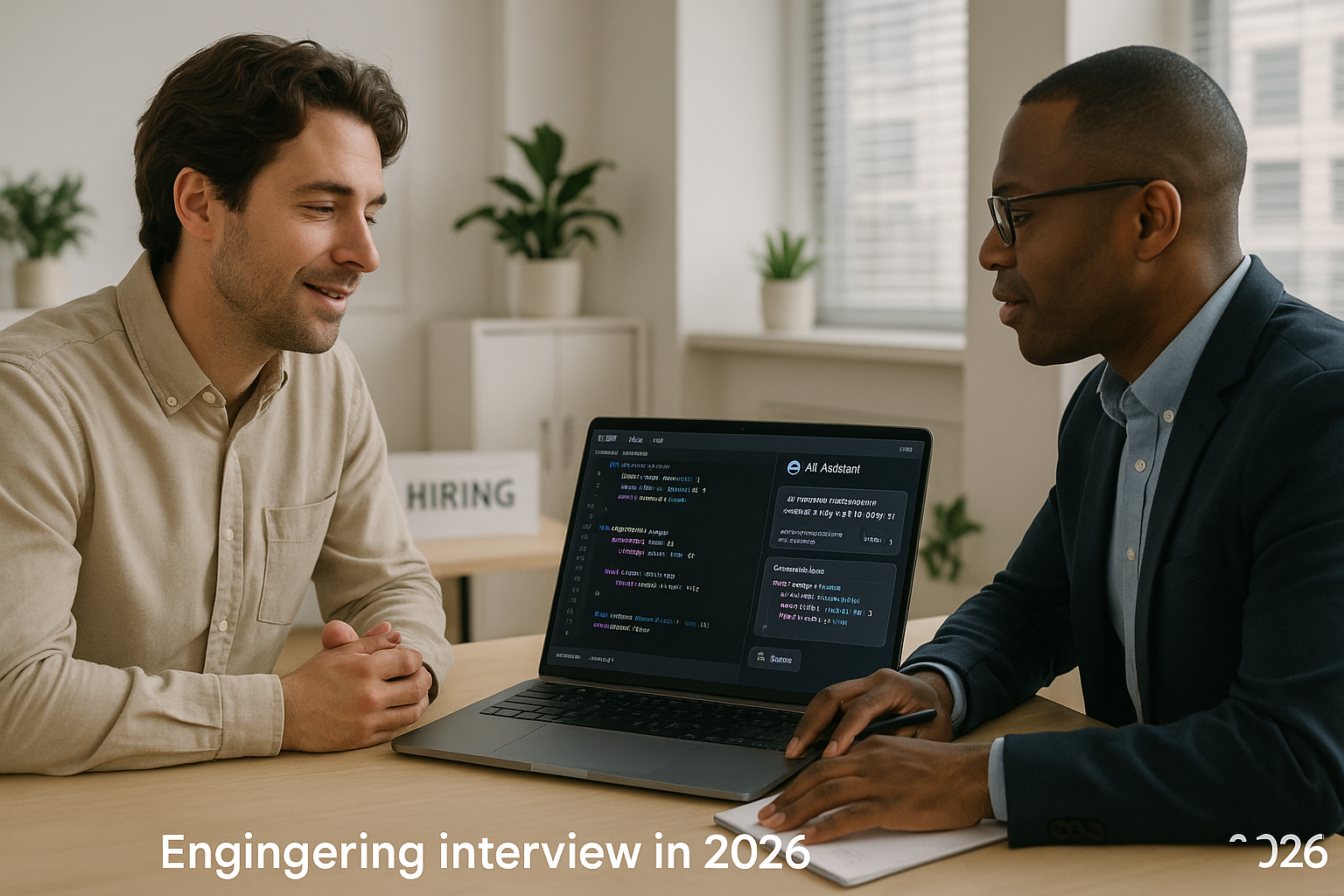
DoorDash’s decision to rebuild parts of its engineering interview process around AI is notable for one simple reason: it treats modern software work as it actually exists, not as it looked a decade ago.
That doesn’t mean traditional coding interviews vanish overnight, or that every company should copy DoorDash’s process wholesale. But it does mean something important has moved into the open. A large employer has publicly said that the standard LeetCode-style approach is no longer the best proxy for day-to-day engineering ability in every context. DoorDash laid out that reasoning in its own post, “DoorDash is rebuilding its engineering interviews around AI”. The shift quickly spread through developer communities too, including a widely shared Reddit discussion about DoorDash moving away from LeetCode interviews. Coverage also surfaced through Google News aggregation of the story.
The interesting part is not the headline by itself. The interesting part is what it forces hiring teams to admit: if engineers now work with AI tools in real environments, interviews that ban that reality entirely may be measuring something narrower than intended.
That is the real opening here for engineering leaders, recruiters, and products like Nuvis.
What DoorDash is actually signaling
The easiest way to misread this story is to flatten it into a trend piece about “AI replacing LeetCode.” That is too broad, and it skips the operational point.
What DoorDash appears to be signaling is more practical:
- the company wants interviews to better resemble real engineering workflows
- it sees AI use as part of the job environment, not as an irrelevant distraction
- it believes candidate evaluation should focus more on judgment than memorized puzzle performance
That is a narrower claim, but it is also more credible.
Most software engineers do not spend their days solving isolated algorithm puzzles from memory under timed pressure. They spend their time reading existing code, debugging unfamiliar systems, checking assumptions, writing and revising code with tools, validating outputs, and communicating tradeoffs. If a company wants to hire people who can work effectively in that setting, it makes sense to test for those behaviors more directly.
DoorDash’s public write-up matters because it puts a recognizable brand behind that argument. The Reddit reaction matters because it shows candidates immediately understood the implication: this is not just a branding tweak. It changes what kind of preparation and what kind of skill expression the interview rewards.
Why this lands differently in 2026
The same announcement would have sounded much softer a few years ago.
In 2026, it lands differently because AI tooling is no longer hypothetical in engineering organizations. Candidates and hiring managers have both seen the workflow change. Engineers now commonly use AI assistance to draft code, compare approaches, generate tests, summarize unfamiliar APIs, and accelerate debugging. The strongest engineers still need to think clearly, verify carefully, and make good decisions. But the environment around that work is undeniably different.
That matters for hiring because the old interview contract has become less believable.
For years, the implicit rule was: ignore the tools you would actually use on the job, and prove your worth by reproducing solutions manually in a constrained setting. That approach offered standardization, but it also introduced distortion. Some companies accepted that tradeoff because there were few scalable alternatives.
Now there are alternatives.
That does not automatically make every AI-enabled interview better. Plenty of sloppy versions will be noisy, gameable, or superficial. But it does mean companies can no longer defend every outdated screen with “this is just how technical hiring works.” DoorDash is one visible example of a company choosing not to hide behind that excuse.
The specific weakness in classic LeetCode interviews
LeetCode-style interviews are not useless. They can test baseline problem solving, communication under pressure, and familiarity with core computer science concepts. For some roles, especially algorithm-heavy or highly selective generalist pipelines, that signal may still be useful.
The issue is not that these interviews are always bad. The issue is that they became a default far outside the situations where they were strongest.
Three problems keep showing up.
1. They often reward rehearsal more than real work readiness
A candidate who has spent months drilling common patterns may outperform a stronger engineer who has been busy shipping production systems. That does not make the prepared candidate weak. It just means the score is partly measuring interview-specific training.
Hiring teams know this, even when they do not say it plainly.
2. They compress engineering ability into a narrow performance slice
Real engineering includes problem framing, debugging, code review, risk recognition, edge-case thinking, judgment about tradeoffs, and tool use. A timed puzzle captures only a small piece of that mix.
3. They create avoidable candidate skepticism
Many experienced engineers have learned to see these rounds as detached from the actual work. That does not always stop them from participating, but it does affect how they view the employer. An interview process that feels generic can make a company feel generic too.
DoorDash’s shift stands out because it addresses that third point as much as the first two. It tells candidates: we know the job changed, and we are willing to adjust the evaluation with it.
What a good AI technical interview should measure
If companies are going to replace or supplement LeetCode interviews with AI-based assessments, the standard should be clear. A good AI technical interview is not a test of whether someone can get a chatbot to spit out code quickly.
It should measure whether a candidate can work intelligently in an AI-assisted environment.
That includes:
- framing the problem well before jumping into code
- deciding when AI help is useful and when it is not
- spotting incorrect or incomplete AI output
- verifying behavior with tests, edge cases, or reasoning
- explaining tradeoffs clearly
- recovering from bad directions without getting lost
- keeping security, maintainability, and reliability in view
Those are not soft extras. They are central to modern engineering work.
This is where many lazy takes on AI interviewing go wrong. They assume the presence of AI lowers the bar. In practice, it can raise the bar on judgment. When tool assistance is available, raw code generation matters less than the ability to guide, critique, and verify the output. That is often closer to senior-quality engineering than speed-solving a familiar array problem.
What hiring teams should learn from DoorDash
The main lesson is not “copy DoorDash.” It is “revisit what your interview is really trying to predict.”
A useful hiring process should answer a few uncomfortable questions honestly.
Are we testing the actual work?
If the role involves debugging services, reviewing code, making architecture choices, and using AI-assisted workflows, then an interview made entirely of abstract puzzles probably misses meaningful signal.
Are we rewarding the right kind of preparation?
There is nothing wrong with preparation. But there is a difference between preparing to do the job and preparing to pass a narrow artificial test. Hiring teams should know which one they are incentivizing.
Are we measuring reasoning, or just output?
When AI enters the process, companies need to look beyond whether a candidate reached a plausible final answer. They need to inspect how the candidate got there. Did they challenge bad suggestions? Did they test assumptions? Did they show control over the process?
Can we make the process structured enough to be fair?
This is the operational challenge. The best argument for classic coding screens was always consistency. Every candidate faced similar constraints, and interviewers had a familiar scoring frame.
AI-enabled interviews need that same discipline. Without clear prompts, rubrics, and interviewer guidance, the process can become subjective fast. So the opportunity is not simply to allow AI. The opportunity is to build a structured way to evaluate AI-assisted engineering behavior.
Why this is directly relevant to Nuvis
This is where the story stops being abstract and becomes product-relevant.
If companies are serious about AI-centered interviewing, they need infrastructure. They need a system that does more than let candidates open a model during a screen. They need a way to create consistent tasks, observe behavior, capture reasoning, and score performance in a way interview panels can actually use.
That is the practical case for an AI interview assistant.
Nuvis fits naturally into this transition because the market problem is becoming easier to explain. Hiring teams do not need a lecture on whether AI belongs in engineering work anymore. That debate is largely over inside many organizations. The harder question now is how to interview for AI-assisted work without creating chaos.
A strong AI interview assistant should help with four concrete things.
Structured realism
The interview should feel closer to actual engineering work without becoming a free-form mess. Candidates need realistic tasks; interviewers need comparable signals.
Observable reasoning
The product should help hiring teams see not just the final artifact, but the candidate’s approach. How did they prompt? What did they accept too quickly? Where did they slow down and verify? Where did they catch a mistake?
Better calibration across interviewers
One hidden weakness in many hiring loops is scoring drift. If each interviewer interprets AI-assisted work differently, the process becomes noisy. A good platform can tighten the rubric and reduce that variance.
Candidate credibility
Candidates are more likely to respect a process that resembles real work. That does not mean they will find it easy. It means they will at least recognize the test as relevant.
Nuvis’s opportunity is not merely to ride a trend headline. It is to help companies operationalize a format they increasingly want but do not yet know how to run well.
The practical risks companies should watch
Not every AI interview design is automatically better than LeetCode.
There are real failure modes:
- overvaluing prompt fluency instead of engineering judgment
- creating inconsistent interviewer expectations
- letting tool access mask weak fundamentals
- failing to define what “good verification” looks like
- turning the process into vague collaboration theater
These are fixable problems, but only if teams are honest about them.
A good AI technical interview still needs constraints. It still needs a scoring model. It still needs to distinguish between a candidate who steers the tool intelligently and one who passively copies output. If companies ignore that design work, they will simply replace one flawed ritual with another.
That is why DoorDash’s move is important but not self-justifying. Publicly changing direction is the easy part. Building a useful, fair, repeatable process is the hard part.
What engineering leaders should do next
If you run engineering hiring, this is a good moment for a sober review of your process.
Start with the role, not the ritual.
List the work your team actually does. How much of it depends on implementation from memory? How much depends on debugging, system understanding, tool use, review quality, and tradeoff judgment? The answer should shape the interview.
Then review where candidates struggle in your current loop. Are they failing for reasons that predict poor job performance, or for reasons that mainly predict poor puzzle performance?
Next, decide where AI belongs in evaluation. For some roles, it may belong in only one round. For others, it may be part of the whole technical assessment. The point is to be explicit.
Finally, invest in instrumentation. AI-enabled interviews need tighter design than many teams expect. You need tasks, rubrics, examples of strong and weak behavior, and a way to compare candidates fairly. This is exactly where purpose-built platforms can matter.
Final take
DoorDash’s AI interview shift in 2026 matters because it makes a quiet industry tension visible. The old technical interview model promised fairness through standardization, but often at the cost of realism. AI-assisted engineering work puts pressure on that tradeoff.
What DoorDash has done is not prove that every company should abandon LeetCode interviews. It has done something more useful: it has legitimized the idea that interviews should reflect the environment engineers actually work in now.
That is a meaningful shift in engineering hiring.
For hiring teams, the takeaway is practical. Stop asking whether AI should exist in the interview abstractly. Ask what skills you truly want to measure, what modern work looks like on your team, and what structure you need to evaluate that work fairly.
For Nuvis, the implication is clear. As more companies move toward AI-aware hiring, the need for a well-designed AI interview assistant becomes less theoretical and more operational. The winning products will not just add AI to the process. They will help companies build interviews that are realistic, measurable, and worth trusting.