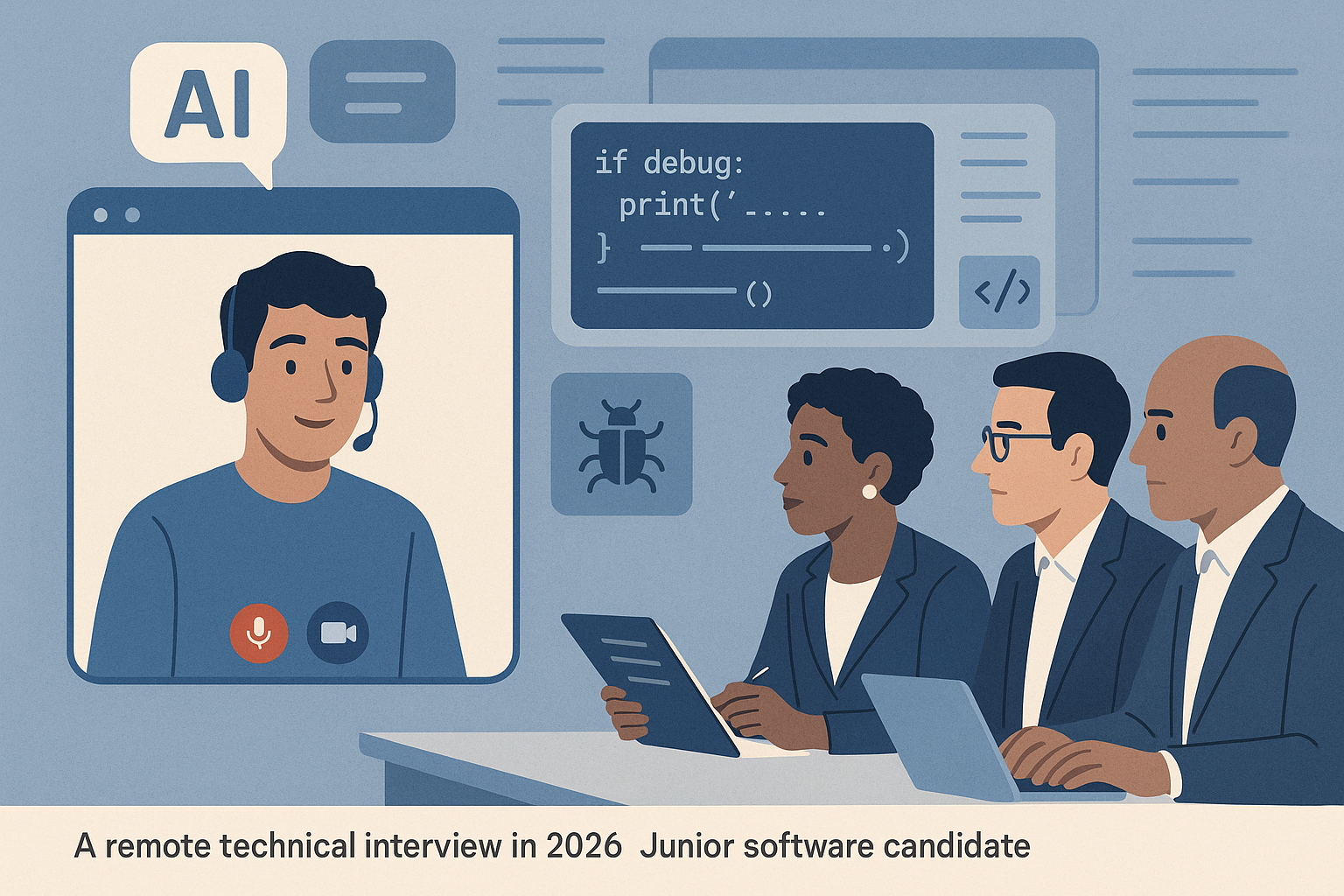
Technical interviews have always had blind spots. In 2026, one of the biggest is no longer hypothetical: candidates can bring AI into the room, whether a hiring team designed for that reality or not.
That does not mean every candidate is cheating. It does mean the old assumption behind many interview loops has weakened. A coding round used to test some mix of memory, reasoning, communication, and calm under pressure. Now it may also measure how well someone uses an off-screen prompt, how polished an AI-generated explanation sounds, or how effectively a candidate has trained themselves to lean on tooling they do not fully understand.
For junior developer hiring, this matters even more. Entry-level candidates have fewer past projects, thinner resumes, and less on-the-job evidence to evaluate. When teams cannot lean on prior work history, they lean harder on interviews. If those interviews are easier to game or easier to misread, hiring gets worse in both directions: weak candidates slip through, and promising candidates get filtered out for the wrong reasons.
That is the practical problem behind the current debate over the AI interview assistant era. The important question is not whether AI exists in hiring. It clearly does. The important question is whether your interview process still tells you something trustworthy about how a person will work on a real engineering team.
Recent discussions from candidates and hiring participants show how messy the signal has become. In one Reddit thread, a poster who said they had sat on 40 hiring committees in a year described just how noisy applicant evaluation now feels, especially when large pools produce many candidates who look similar early on (hiring committees discussion). In another thread, experienced developers debated what happens when junior engineers learn to code with heavy AI support from the start, and whether that changes what employers should expect them to do independently (junior devs who learned with AI). Add in posts from frustrated graduates and burned-out LeetCode grinders, and the pattern is hard to ignore: teams are relying on signals that many candidates no longer trust and that many employers no longer find especially predictive.
This article is not an argument for banning AI, and it is not an argument for accepting every new tool uncritically. It is a more boring and more useful point: if AI is part of the environment, technical interviews need to be redesigned around that fact.
The old interview bargain is breaking down
For a long time, most software interview loops ran on a quiet bargain.
Candidates agreed to solve artificial problems under constrained conditions. Companies agreed to treat performance on those problems as a rough proxy for job readiness. Everyone knew the proxy was imperfect, but it was scalable, familiar, and good enough to keep hiring moving.
That bargain is weaker now for three reasons.
First, many candidates do not learn programming in a tool-free environment anymore. They learn with autocomplete, AI chat, code generation, bug explanations, and refactoring suggestions available by default. Some use those tools well and build strong intuition. Some never build the intuition.
Second, remote interviewing makes hidden assistance easier. Even with clear rules, a company cannot assume every candidate is operating under identical conditions in a home office.
Third, interview prep itself has changed. Candidates can use AI to generate mock answers, summarize data structures, explain system design tradeoffs, and rehearse likely follow-ups. That can be helpful preparation. It can also create a polished surface that overstates actual understanding.
The result is not that interviews have become useless. It is that many teams are still interpreting them as if none of this changed.
That creates a predictable mismatch. A candidate may appear smooth in a conventional coding round and then struggle badly when asked to debug, defend a tradeoff, or work through an ambiguous requirement. Another candidate may be less polished in a memorized format but much stronger at real engineering behaviors like isolating failure, asking clarifying questions, and improving a rough first draft.
A good hiring process should be able to tell those people apart.
Why junior developer hiring feels the strain first
At senior levels, companies can sometimes lean on work history, architecture ownership, shipped systems, and references. For junior hiring, there is usually less to inspect. A new graduate or career switcher may have internships, classwork, side projects, and some take-home exercises. That is useful, but it is not the same as years of observed execution.
So interviews carry more weight.
That would be manageable if the market were calm and the signals were clean. But they are not. Applicant volume remains high in many software roles, and early-stage filtering often reduces people to credentials, keywords, and test performance. The hiring-committee Reddit thread captures the feeling many managers and recruiters have right now: large pools create a lot of sameness on paper, and the real differences only show up later, if the process is designed well enough to surface them (discussion here).
Junior candidates also face another problem: AI can help them complete work before they fully understand it. That does not make them lazy or dishonest. It just changes what completion means.
A project assembled with extensive AI help can still represent real learning. But it can also hide thin fundamentals. That concern shows up clearly in the discussion about junior developers who learned with AI, where experienced engineers worried less about tool usage itself and more about whether some new developers were skipping the mental models needed to debug and reason independently (thread here).
You can see the candidate side of the same issue in a post from a recent graduate who said they were months out of school and struggling to write basic code (recent graduate thread). One Reddit post is not a dataset, but it does reflect a real hiring concern: credentials and completion do not always map cleanly to working fluency.
For junior hiring teams, that means the usual shortcuts are less safe than they used to be.
The LeetCode problem is now an AI problem too
The coding-interview world was already under pressure before generative AI became common.
Candidates complained, often fairly, that many interview loops rewarded rehearsal over engineering judgment. Hiring teams defended those loops, also often fairly, because they were standardized and easier to scale than open-ended evaluation.
AI has not erased that tension. It has made it sharper.
If a candidate spends years preparing for algorithm screens and still gets nowhere, as one frustrated Reddit poster described in a thread about doing LeetCode for two years only to be rejected (LeetCode rejection thread), the obvious conclusion is not that interview prep never matters. The better conclusion is that a narrow prep game produces a narrow signal.
Now add an AI interview assistant on top of that environment. A candidate may be able to get subtle hints, clean up phrasing, generate edge cases, or reconstruct a known pattern more convincingly than they could alone. If your loop mostly checks whether someone can arrive at a familiar answer shape, then AI does not just create an integrity problem. It exposes that your signal was fragile to begin with.
That is the key point many hiring teams miss. AI is not only changing candidate behavior. It is stress-testing interview design.
If a process becomes unreliable the moment candidates gain access to modern tools, then the process was probably overweighting output and underweighting ownership.
What companies actually need to know now
Most hiring teams are not trying to answer the philosophical question of whether candidates should use AI. They are trying to answer four practical questions:
- Can this person understand the problem in front of them?
- Can they make progress when the first answer is incomplete or wrong?
- Can they explain what they are doing and why?
- Can they use tools without outsourcing judgment?
Those are not new questions. But in 2026 they need to be made much more explicit.
A junior engineer does not need perfect recall or advanced systems knowledge to be hireable. They do need signs of foundation: the ability to decompose a task, notice when something does not make sense, test assumptions, and respond well to feedback.
An interview process that cannot observe those things directly will increasingly confuse confidence with competence.
What better technical interviews look like in 2026
The best update is not a dramatic one. Most teams do not need to throw out every coding round and replace it with an elaborate anti-AI system. They need to make their interviews more specific, more probe-heavy, and more aligned with actual work.
Here are the changes that matter most.
1. Put more weight on reasoning out loud
If a candidate can explain what they notice, where they are uncertain, and what they want to test next, you learn much more than you do from a finished answer alone.
This does not mean rewarding nonstop talking. It means creating checkpoints where the candidate has to make their model visible. Why this data structure? Why this tradeoff? Why did this fail? What would you try next?
A generated solution is easier to fake than generated ownership.
2. Add debugging to the loop
Debugging is a much more job-relevant signal than many whiteboard exercises. It forces candidates to inspect behavior, formulate hypotheses, and revise their thinking in real time.
That is also where shallow understanding tends to break down. Someone who relied heavily on AI to produce an answer may struggle to explain why a bug appears, how to isolate it, or what a safe fix would look like.
For junior roles, debugging also gives nervous but capable candidates a fairer chance to show practical reasoning even if they are not polished performers.
3. Use follow-up questions that test ownership
A lot of interview loops still stop too early. A candidate reaches a plausible answer and the interviewer moves on.
That is exactly where stronger signal begins.
Ask what happens on edge cases. Ask how the approach changes if memory becomes constrained. Ask how they would test it. Ask what part of the solution they feel least confident about. If the candidate used an AI-shaped answer pattern, those follow-ups often reveal whether they truly understand the structure underneath it.
4. Decide your AI policy on purpose
Many teams now have a vague, inconsistent stance: unofficially suspicious, officially unclear.
That is a bad combination.
If you want a no-AI baseline round, say so plainly and explain why. If you want a tool-allowed round because the role includes AI-assisted coding in practice, say that plainly too and define what good tool use looks like.
The problem is not having one universal policy. The problem is pretending policy does not matter.
5. Evaluate learning behavior, not just current polish
In junior developer hiring, one of the most valuable signals is how quickly a candidate improves during the conversation. Do they absorb a hint and apply it well? Do they recover from a wrong turn? Do they ask better questions after feedback?
That is often more predictive than whether they recognized a problem pattern in the first 90 seconds.
Where Nuvis fits
Nuvis is useful here not because it magically solves hiring, but because teams need more structure around what they are actually trying to observe.
When interview loops are vague, interviewers default to surface impressions. One interviewer likes confidence. Another likes speed. Another is unconsciously looking for a version of their own background. In a noisy hiring market, that kind of inconsistency gets expensive fast.
Nuvis can help teams make interviews more evidence-based in a few concrete ways.
First, it helps standardize what counts as strong performance. Instead of treating a coding round as a general vibe check, teams can define the signals they want to see: problem decomposition, debugging approach, tradeoff reasoning, communication clarity, and response to feedback.
Second, Nuvis can help teams design interview stages that match role requirements. If a junior role requires independent fundamentals, the process should validate them directly. If the role includes AI-assisted coding in daily work, the process can incorporate tool-aware tasks instead of pretending that modern development happens in a vacuum.
Third, Nuvis can improve fairness in junior hiring by giving interviewers a clearer rubric for potential. That matters because a lot of promising entry-level candidates do not have polished resumes or perfect interview instincts, but they do show strong reasoning once the interview asks the right questions.
Fourth, Nuvis can reduce the mismatch between what teams say they want and what their loops actually measure. Many companies claim to value problem-solving, adaptability, and judgment. Then they run interviews that mostly reward fast recall. A better system closes that gap.
In other words, the Nuvis angle is not “AI changed everything, so buy a platform.” It is simpler than that: if your hiring team wants a more trustworthy read on candidates in the age of the AI interview assistant, you need a more deliberate way to design and evaluate interviews.
A practical reset for hiring teams
If your team is revisiting technical interviews this year, start with a short audit.
Ask these questions:
- Which rounds truly test reasoning, and which mainly test rehearsal?
- Where could a candidate get substantial hidden help without changing the apparent outcome?
- Do interviewers know what signals matter most for junior roles?
- Are you evaluating a candidate's final answer, or their path to it?
- Does your AI policy match the way the actual job is done?
Then make a few targeted changes instead of trying to solve everything at once.
Add one debugging-heavy round. Tighten your follow-up questions. Rewrite rubrics so they emphasize ownership and adaptation. Be explicit about tool usage. Review debriefs for vague language like “seemed smart” or “didn't inspire confidence” and replace it with observed evidence.
Those are not flashy changes. They are the kind that make interviews more believable.
The real hiring question now
The defining question of 2026 is not, “Did this candidate use AI?”
A much better question is, “Can this candidate think, explain, and execute responsibly in a world where AI is available?”
That is the environment software teams actually operate in. The strongest candidates will not be the ones who pretend tools do not exist. They will be the ones who can use tools without surrendering judgment.
Hiring teams need interview processes that can tell the difference.
The companies that adapt will make better junior hires, waste less time on noisy signals, and create interview loops that feel more credible to candidates as well as interviewers. The ones that keep relying on brittle, easily distorted proxies will keep getting mixed results and wondering why the pipeline feels harder to trust.
That is why the AI interview assistant conversation matters. Not because it introduces a totally new hiring problem, but because it forces an overdue redesign of technical interviews and junior developer hiring.
And that is exactly where Nuvis can be most useful: helping teams build interview processes that measure real problem-solving, not just polished output.