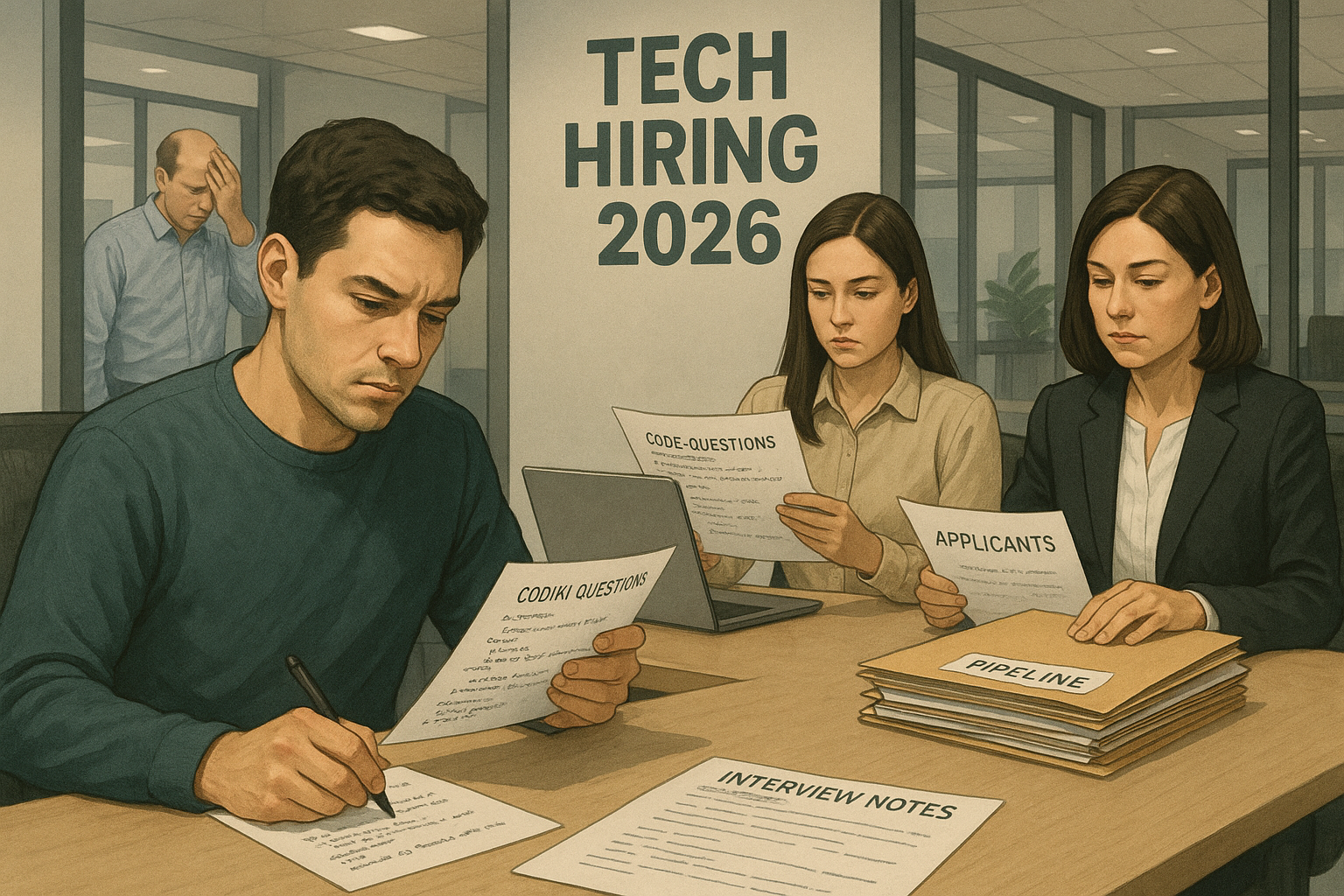
The useful way to read the current conversation around Oracle layoffs is not as one more dramatic tech headline. It is as a hiring-market stress test.
When a company with Oracle’s reach becomes the center of a layoffs discussion, the impact does not stop with the people directly affected. Engineers who were not planning to interview start brushing up on coding rounds. Recruiters see more inbound applicants for the same roles. Hiring managers get pickier because they can. And candidates who were already uneasy about the market become much more deliberate about preparation.
That is why this moment matters for Nuvis. The opportunity is not to sensationalize layoffs. It is to explain what actually changes when layoffs collide with a slower hiring market: technical interview prep becomes more urgent, interview process quality matters more, and tools that help candidates practice and help teams evaluate consistently become easier to justify.
Public discussion gives us a grounded starting point. One widely shared Reddit thread focused on Oracle job cuts and the blunt way workers described receiving the news (Reddit discussion on Oracle layoffs). Another post analyzed 11,000 developer job listings to identify what employers are actually asking for in today’s market (analysis of 11k dev jobs). Broader attention also shows up in the Google Trends Canada trending feed, which is useful not because it proves a thesis on its own, but because it reflects how quickly employment anxiety turns into search behavior.
Put those signals together and a practical picture emerges: people are not only reacting to layoffs news, they are changing how they prepare for hiring.
Why Oracle layoffs matter beyond Oracle
Every major layoffs story creates a first-order effect and a second-order effect.
The first-order effect is obvious. People lose jobs. Teams are disrupted. Managers scramble. Internal trust takes a hit.
The second-order effect is where hiring behavior changes. A large group of experienced candidates enters the market within a short window. That alone is enough to alter the balance between employers and applicants, especially when the broader market already feels slow.
In practical terms, that means:
- more applicants per open role,
- more experienced talent competing for the same seats,
- more pressure on candidates to interview well early,
- and more pressure on hiring teams to sort signal from noise quickly.
That is why the Oracle story matters even to companies that do not compete with Oracle directly. If you are hiring software engineers, data people, infrastructure talent, or technical product roles, you are affected by the behavior shift that follows layoffs. If you are a candidate, you are affected too, whether or not you worked at Oracle.
People often talk about hiring markets as if they change through official announcements. In reality, they change through habits. Candidates apply faster. Recruiters tighten filters. Hiring managers ask for one more round. Engineers who have not interviewed in years suddenly open a leetcode tab, revisit system design notes, and start asking friends for mock interviews.
That behavior shift is the real story.
Technical interview prep becomes urgent when the market feels tighter
In a loose market, a lot of candidates can afford to be rusty. They can learn mid-process, do a few warm-up interviews, and still recover from a weak round. In a tighter market, that gets expensive.
If there are fewer relevant openings, slower recruiter response times, and more competition from experienced applicants, then each interview carries more weight. A candidate may not get five comparable chances in a month. They may get one good shot, then silence.
That changes what technical interview prep means. It is no longer just a box to check before applying. It becomes a short-term risk-management exercise.
For candidates, that usually shows up in a few predictable ways:
- More focused preparation. People stop preparing “for tech interviews” in the abstract and start preparing for the specific kinds of roles still hiring.
- Higher emphasis on communication. Solving the problem matters, but explaining tradeoffs, constraints, and reasoning matters more when interviewers have plenty of options.
- More demand for repeatable practice. Friends and mentors help, but they do not always scale, especially when many people need help at once.
- Less tolerance for winging it. Candidates become less willing to enter a process cold, because a bad early round can shut down momentum.
This is where Nuvis has a credible angle. The strongest message is not that layoffs are “good for interview prep tools.” That sounds opportunistic. The better observation is simpler: when more engineers need to get interview-ready quickly, they need structured practice, useful feedback, and a process that does not waste time.
The slower hiring market changes employer behavior too
It is easy to frame this as only a candidate story, but employers change their behavior just as quickly.
A hiring slowdown does not necessarily make recruiting easier. It often creates a different kind of difficulty. Instead of worrying about too few applicants, teams worry about too many applicants with too little time to evaluate them properly.
That can produce bad habits:
- overreliance on brand-name resumes,
- inconsistent screens,
- too many interview rounds,
- and vague feedback that hides weak decision-making.
The Reddit post analyzing 11,000 developer jobs is relevant here because it reflects something candidates already suspect: companies are asking for specific combinations of skills, experience, and stack familiarity, and job seekers are trying to reverse-engineer those expectations (analysis of 11k dev jobs). Whether you treat that one dataset as definitive or directional, the takeaway is useful. Candidates are adapting to selectivity. Employers need to adapt too.
If a company is receiving more applications because market anxiety is rising after Oracle layoffs, the answer cannot just be “screen harder.” Better hiring teams do four things instead:
1. They define what good actually looks like
Many hiring loops still rely on fuzzy consensus. One interviewer rewards speed, another rewards elegance, another rewards communication, and nobody agrees on which mistakes are fatal. In a crowded market, that creates noise.
Teams should write down the competencies they care about for the role: coding accuracy, debugging approach, system design judgment, prioritization, collaboration, and communication. That sounds basic, but it is still missing in a surprising number of hiring processes.
2. They reduce time-to-signal
If candidate volume rises, bloated interview loops become even more damaging. Strong applicants drop out. Weak applicants linger. Recruiters drown in scheduling and note-chasing.
The practical fix is not more rounds. It is earlier clarity. A good process gets to meaningful evidence quickly.
3. They improve candidate guidance
Anxious candidates perform worse when the process feels opaque. Clear expectations are not charity; they improve signal. If you tell candidates what the interview is trying to evaluate, they can prepare more honestly and show relevant strengths.
4. They use tools to support consistency, not replace judgment
This is the sensible place for an AI interview assistant in the hiring conversation. Not as a magic evaluator. Not as a shortcut around human judgment. As infrastructure that helps candidates practice and helps teams maintain a more structured process.
Used well, that can mean standardized mock prompts, repeatable practice sessions, better interviewer notes, clearer scorecards, and less random variation between one interview and the next.
What candidates should do now if Oracle layoffs changed their timeline
Not every reader is directly affected by Oracle layoffs, but many will recognize the feeling the story creates: “I may need to interview sooner than I expected.” If that is true, the right response is specific, not dramatic.
Start with role targeting, not panic-prep
Do not prepare for every kind of technical interview at once. A backend engineer interviewing for distributed systems roles needs a different prep mix than a full-stack engineer targeting startup product teams.
Pick a realistic target cluster of roles and build around that:
- coding and debugging,
- system design,
- architecture tradeoffs,
- behavioral stories,
- and role-specific project discussion.
Breadth feels productive when you are anxious. Specificity is usually what works.
Practice explanation under pressure
A common mistake in technical interview prep is over-indexing on final answers. In today’s market, explanation quality is often what separates candidates who move forward from candidates who are described as “smart, but unclear.”
Practice saying the obvious things out loud:
- why you chose one approach over another,
- what assumptions you are making,
- where the bottlenecks are,
- what you would test first,
- and what you would change if scale or reliability requirements changed.
This is one reason mock interviews matter. They reveal whether your thinking is visible to another person, not just whether you can eventually solve the problem.
Refresh your market-facing materials
When layoffs dominate public discussion, people often rush into applications with old resumes, stale project summaries, and weak outreach messages. That is understandable, but it costs them.
Before sending out a flood of applications, update the basics:
- resume bullets with concrete outcomes,
- a current LinkedIn profile,
- short summaries of major projects,
- and a version of your background that matches the roles you want now.
Build a repeatable prep loop
The best prep system is the one you will actually keep using for two or three weeks under stress. That usually means short cycles:
- one coding session,
- one explanation-focused mock,
- one system design rep,
- one review of mistakes,
- then adjust.
This is where an AI interview assistant can be genuinely useful. Not because it can replace a skilled interviewer, but because it can provide repetition, structure, and quick feedback when human help is limited.
What Nuvis can say credibly right now
Nuvis should resist the temptation to turn this into a sweeping story about the entire labor market. The strongest editorial position is narrower and more believable.
Here is the practical version:
- Oracle layoffs have made interview readiness feel immediate for more engineers.
- A slower market increases the cost of weak interview performance.
- Hiring teams need cleaner ways to evaluate larger candidate pools.
- Candidates need more structured, repeatable preparation.
- An AI interview assistant is useful when it improves practice quality and process consistency.
That framing works because it matches what people actually do after layoffs news breaks. They look for an edge, a system, and a way to waste less time.
It also gives Nuvis a position that is more grounded than generic AI messaging. The point is not that AI is coming to hiring. The point is that hiring gets messy under stress, and practical tools are valuable when they reduce that mess.
A sharper content and distribution angle for this story
If Nuvis publishes on this topic, the article should sound like market analysis from someone who understands recruiting mechanics, not commentary from the cheap seats.
That means avoiding broad claims like “layoffs are transforming hiring forever.” Maybe they are, maybe they are not. A stronger editor says what can be observed now.
For example:
- layoffs increase candidate urgency,
- urgency increases prep activity,
- more prep raises the baseline,
- more applicants force employers to tighten process,
- and process quality becomes a competitive advantage.
That is a clear line of reasoning. It is specific enough to be useful and modest enough to be credible.
The social version should be equally sharp. The best X angle is not outrage or gloom. It is a practical market read:
Oracle layoffs are not only a company story. They are a reminder that when more engineers hit the market at once, technical interview prep gets more serious and hiring teams need better signal.
That gives people something concrete to react to.
The bigger point: interview readiness is becoming ongoing career maintenance
One reason this topic resonates is that many engineers have started to treat interview readiness less like a one-time cram session and more like background career maintenance.
That does not mean everyone should be constantly grinding interview questions. It means the old idea of “I will prep when I need to” feels less reliable in a market where layoffs can reset someone’s timeline overnight.
If Oracle layoffs in 2026 push more people toward that mindset, the effect will last beyond this particular news cycle. More candidates will keep their resumes current. More will maintain project stories. More will do occasional coding and system design practice even while employed.
For employers, that means candidate quality may become more polarized: some people will arrive visibly prepared, while others will look surprisingly rusty. For recruiting teams, the process itself will matter more because prepared candidates are more likely to notice bad hiring mechanics and walk away.
That is why the real takeaway here is not simply that layoffs happened. It is that layoffs make hidden weaknesses in the hiring system easier to see.
Candidates see whether they are actually ready. Employers see whether their process can handle pressure. Products like Nuvis become more relevant when they help both sides deal with that pressure in a more structured way.
Final takeaway
The most useful conclusion is also the least dramatic. Oracle layoffs in 2026 are not important only because they are big and emotional. They matter because they change behavior.
They push more engineers toward immediate technical interview prep. They raise the stakes of a slower hiring market. They expose weak recruiting processes. And they make practical preparation tools more valuable than vague career advice.
For Nuvis, that is the opening: be the product and the voice that treats interview readiness as a workflow problem, not a motivational problem. That is more credible, more specific, and much closer to what candidates and hiring teams actually need right now.