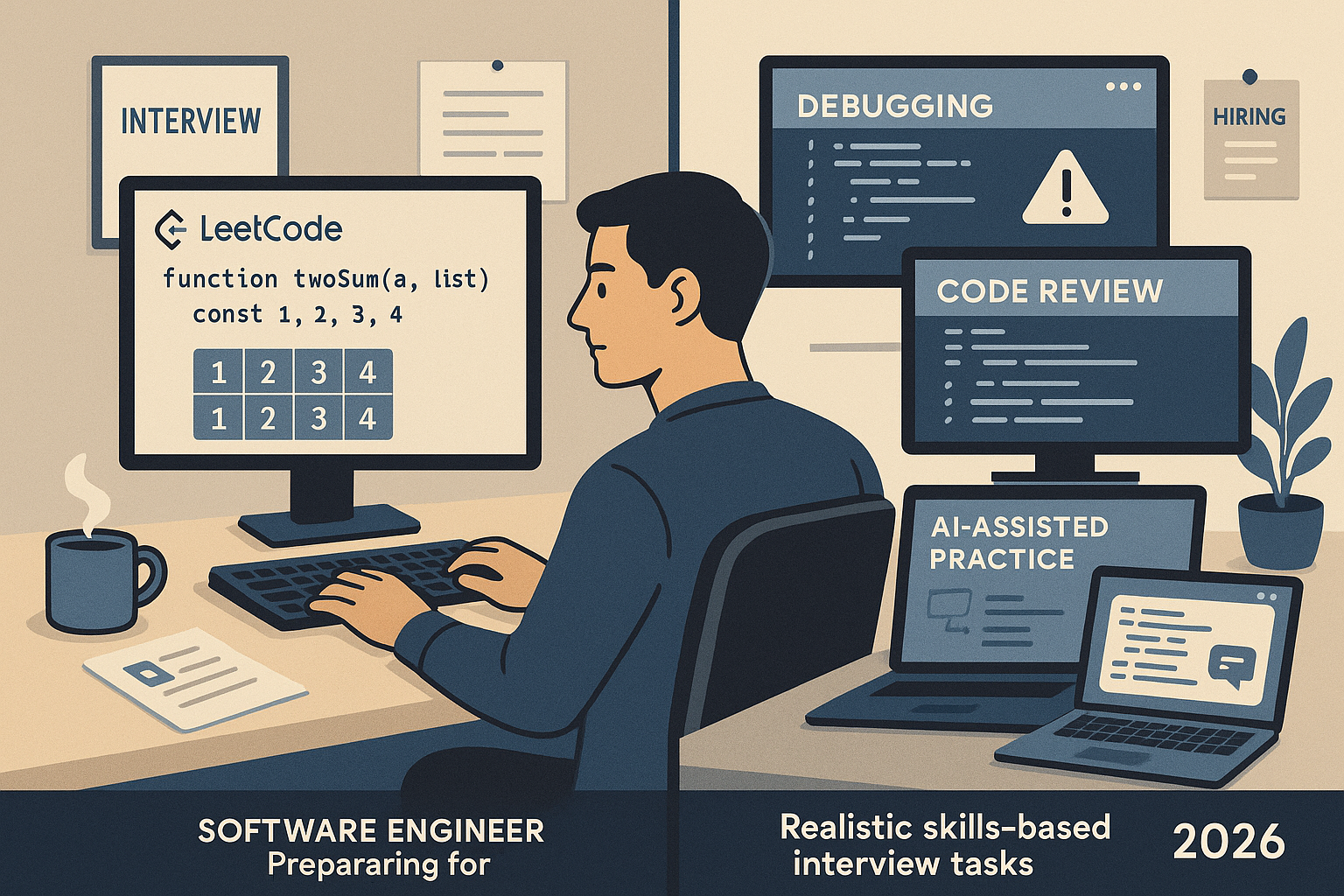
For a long time, the standard advice for software candidates was almost embarrassingly simple: open LeetCode, grind hundreds of problems, memorize patterns, and hope the interview loop rewards the same kind of performance. That advice was never universally true, but it was common enough that many candidates treated it as law.
In 2026, that playbook looks less stable.
Not because coding fundamentals stopped mattering. Not because algorithms are irrelevant. And not because every company suddenly built a better process. The real change is that more people are openly saying the quiet part out loud: a lot of technical interview prep has drifted away from the work itself.
You can see that shift in candidate conversations. In one widely shared Reddit thread, engineers argue that the old LeetCode-centered process is breaking down as a default hiring filter, especially when companies are not even hiring in ways that justify the burden (r/leetcode discussion). In another, job seekers describe the experience of getting a software job as a kind of drawn-out humiliation ritual rather than a serious evaluation of ability (r/cscareerquestions discussion). Broader reporting also points to employers rethinking how they assess talent as hiring markets tighten and process quality matters more (Google News coverage).
That does not mean LeetCode is "dead." It means the LeetCode grind no longer feels like a complete answer to technical interview prep in 2026.
What changed in 2026
The most important shift is not that engineers suddenly dislike hard interviews. Candidates have always complained about bad processes. What is different now is that the gap between interview performance and real work is harder to defend.
A backend engineer may spend a normal week tracing a production bug, reviewing a risky database migration, improving observability, and discussing tradeoffs with product and infra teams. A frontend engineer may spend their time untangling state issues, improving accessibility, refactoring brittle UI code, and negotiating scope. A senior engineer may mostly be making decisions under constraints, not racing through graph problems on a timer.
Yet many technical interviews still ask candidates to perform in a narrow, artificial mode: no context, no documentation, no collaboration, and no tools beyond a shared editor and whatever they can recall from memory.
That mismatch has become more visible for three reasons.
1. Candidates are less willing to pretend the process makes sense
The Reddit threads above matter not because every comment is correct, but because they show how candidates talk when they are no longer trying to sound agreeable. The tone is blunt. People are frustrated with interview loops that consume evenings, weekends, and emotional energy while providing little evidence that the company knows how to evaluate engineers.
That matters for employers. Once a process is widely seen as performative, it stops functioning as a neutral screen. It becomes part of your reputation.
2. Hiring teams need clearer signal
When budgets are tighter and headcount is more scrutinized, interview theater gets expensive. A process can feel rigorous and still be weak. Four rounds of algorithm screens may produce a lot of confidence and not much signal if the role actually depends on debugging, judgment, communication, and shipping work through messy constraints.
Hiring teams are starting to care less about whether a loop looks hard and more about whether it gives useful evidence.
3. AI changed the baseline for how engineers work
This is the part many companies still treat awkwardly.
Real engineers use AI now. They use it to summarize docs, draft tests, explain errors, compare approaches, speed up boilerplate, and sanity-check implementation details. Good engineers do not outsource judgment to AI, but they do work with it.
That creates an obvious tension. If modern engineering work includes AI-assisted workflows, then technical interview prep built entirely around isolated puzzle solving starts to look even less realistic. The question for employers is no longer just, "Can this person solve an abstract problem alone under pressure?" It is also, "Can this person reason well, verify outputs, use tools responsibly, and produce sound work in the way modern teams actually operate?"
Why the LeetCode grind still exists
It is worth being fair here. The LeetCode grind did not become common by accident.
Algorithm-heavy interviews offer a few real benefits:
- they are easier to standardize than open-ended assessments
- they can be administered quickly at scale
- they give interviewers a familiar scoring framework
- they sometimes do test useful fundamentals like data structures, complexity tradeoffs, and code clarity under pressure
The problem is not that these interviews are always useless. The problem is what happened when they became the default for too many roles.
Once a format becomes dominant, candidates optimize for it. A whole prep economy forms around pattern recognition. Interviewers get comfortable with it. Recruiters can schedule it. Eventually, convenience starts masquerading as validity.
That is how a method with limited but real value turns into an overused ritual.
What technical interview prep looks like now
If you are a candidate in 2026, the practical takeaway is not "stop studying algorithms." The takeaway is that technical interview prep has to be broader than it used to be.
Strong preparation now often includes four lanes of work.
Fundamentals still matter
You still need core fluency with data structures, complexity, basic algorithms, and clean coding habits. Plenty of companies will continue to screen for them, and even companies moving away from pure puzzle interviews still expect basic coding competence.
If you cannot reason about arrays, maps, recursion, sorting, trees, graphs, or time-space tradeoffs, you are leaving obvious gaps.
Applied coding matters more than pattern memorization
Candidates increasingly run into exercises that look more like normal engineering tasks:
- fixing a failing test
- reading an unfamiliar codebase
- extending existing logic without breaking behavior
- reviewing code and pointing out risks
- explaining why a quick solution would create maintenance pain later
These are not softer versions of technical interviews. In many ways they are harder, because they expose whether you can actually work through ambiguity.
Communication is part of the skill
A surprising number of candidates still prepare as if technical interviews only measure code output. In practice, interviewers often learn as much from your explanation as from your implementation.
Can you narrate your assumptions without rambling? Can you identify a tradeoff instead of pretending there is one perfect answer? Can you recover when you hit a dead end? Can you explain why a bug happened and how you would prevent it from recurring?
That is job-relevant signal.
Tool use is becoming part of the reality
Even when a company bans AI during the actual interview, candidates are preparing with AI. That includes mock interviews, code feedback, debugging practice, explanation drills, and systems design review.
So the practical question is no longer whether AI belongs in technical interview prep. It already does. The question is whether candidates are using it to sharpen judgment or just generate polished nonsense.
That distinction matters. Candidates who let AI do the thinking often become more fragile in live interviews. Candidates who use AI as a practice partner often get better faster.
What better assessments look like
If companies want to move beyond the LeetCode grind, they need a replacement that is more than vague talk about "real-world skills." The useful alternative is not chaos. It is sharper alignment between the job and the assessment.
A better interview loop usually has a few traits.
It tests skills that show up in the role
A role that involves maintaining production systems should probably include some combination of debugging, code reading, and tradeoff reasoning. A role with strong cross-functional demands should assess communication and prioritization, not just coding speed.
It avoids redundant rounds
Candidates often complain about loops that repeat the same signal in slightly different packaging. One hard coding round may be defensible. Three nearly identical screens usually are not. Redundancy wastes everyone’s time and makes companies look unserious about interview design.
It makes expectations clear
A good process tells candidates what will be evaluated. Ambiguity is not rigor. If you want someone to debug, say that. If you want systems design grounded in practical constraints, say that. Candidates do better when they know what kind of work they are being asked to demonstrate.
It creates evidence, not vibes
Interview feedback should be tied to observable behavior: the candidate isolated the bug methodically, wrote maintainable code, caught edge cases, explained tradeoffs well, or struggled to reason about complexity. That is much stronger than the usual fog of "didn't quite feel senior enough."
Why this matters for recruiting teams
This shift is not just a candidate complaint cycle. It changes recruiting economics.
A hiring process that leans too hard on LeetCode-style performance creates three practical problems.
First, it narrows the funnel in ways that may not match the job. Experienced engineers, career switchers, and strong builders with limited prep time can all get screened out for reasons unrelated to on-the-job success.
Second, it hurts candidate experience. Even in a difficult market, strong candidates notice when a company has built an interview loop around habit instead of thought. They notice when the process feels detached from the role. They notice when they are expected to invest huge effort without clarity or respect.
Third, it produces shaky hiring confidence. Teams can end up with very polished interview performers who are weaker in real engineering settings, while missing candidates who would have done excellent work.
That is why skills-based hiring keeps coming up in technical recruiting conversations. Not because it is a trendy phrase, but because teams need a cleaner way to connect assessment to performance.
Where Nuvis fits
This is where the Nuvis angle becomes concrete.
If the market is moving beyond the LeetCode grind, candidates do not just need more content. They need better preparation structure. Employers do not just need another screening tool. They need a more credible way to evaluate real capability.
Nuvis is well positioned if it stays focused on that practical middle ground.
That means helping candidates prepare for the interviews they are actually facing now:
- algorithm rounds where fundamentals still matter
- debugging sessions that reveal thought process
- code review exercises that test judgment
- systems design interviews where tradeoffs matter more than buzzwords
- communication-heavy loops where explanation and prioritization affect outcomes
It also means using the idea of an AI interview assistant carefully. The value is not in giving candidates slick generated answers. The value is in structured practice: surfacing weak spots, simulating realistic prompts, improving explanations, reviewing code decisions, and helping people prepare in a way that transfers to actual interviews.
That is a much stronger position than generic "ace your interview with AI" messaging. Candidates are already skeptical of shortcuts. What they respond to is help that feels specific, honest, and useful.
For employers, the Nuvis opportunity is similar. If interview loops are changing, companies need systems that support more consistent, role-relevant evaluation. That means clearer competencies, better interviewer calibration, and assessments that produce evidence instead of noise.
A practical playbook for companies
If you are rethinking technical interviews in 2026, the work is less glamorous than people expect. It is mostly process design.
Start here:
- Audit every round. Ask what skill each round measures and whether that skill matters in the role.
- Cut duplicate coding screens. If two rounds generate the same signal, remove one.
- Add one realistic task. Debugging, code review, or scoped implementation will often tell you more than another puzzle round.
- Define allowed tools. Be explicit about whether AI, docs, or reference material are permitted.
- Train interviewers to evaluate behavior, not style. Fast talking is not the same as good reasoning.
- Review outcomes. Look at pass-through rates, candidate feedback, and post-hire performance to see whether the process is actually working.
None of this requires abandoning technical rigor. It requires being honest about what rigor is for.
A practical playbook for candidates
Candidates also need a less romantic strategy than "just grind harder."
A stronger prep plan usually looks like this:
- Keep a fundamentals base. You still need coding fluency.
- Practice debugging out loud. Many candidates are weaker here than they realize.
- Do code reading and refactoring drills. A lot of interviews now involve existing code, not blank-page problem solving.
- Prepare tradeoff explanations. Especially for systems design and senior roles.
- Use AI for feedback, not substitution. If an AI interview assistant helps you see patterns in your mistakes, great. If it is writing your thinking for you, that will show.
- Study the company’s process. Tailor your prep to the role instead of treating every interview loop like the same old gauntlet.
That approach is less flashy than marathon LeetCode streaks, but it is closer to how modern technical interview prep actually works.
The bottom line
The LeetCode grind is not disappearing in 2026. But it is losing its monopoly over how candidates prepare and how serious companies think about assessment.
The reason is straightforward: too many people have now seen the mismatch. Candidates see it when interview loops feel detached from the work. Recruiters see it when process quality affects close rates and employer brand. Hiring managers see it when standardized screens produce weak hiring signal. And AI has made the old fiction of tool-free engineering even harder to maintain.
That creates an opening for something better.
Technical interview prep is moving beyond the LeetCode grind in 2026 because the market wants preparation and assessment that feel more like the job: more specific, more evidence-based, and more useful. For Nuvis, that is not a minor messaging tweak. It is the center of the opportunity.
The companies that adapt will make hiring more credible. The candidates who adapt will prepare in ways that actually transfer. And the platforms that help both sides move from ritual to real signal will matter more than the ones still selling the same old grind with new branding.