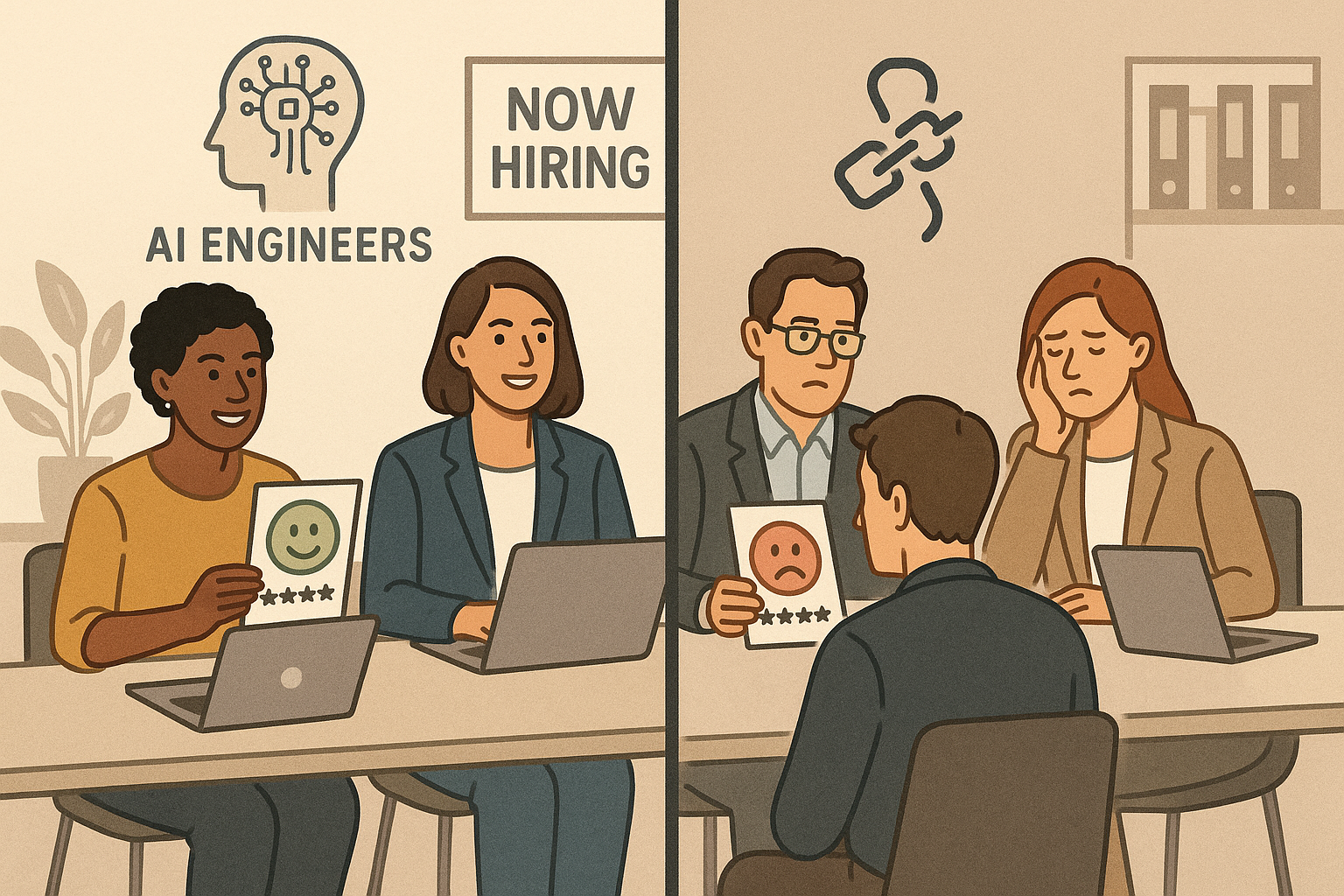
The most useful way to describe AI engineer hiring in 2026 is not “hot” or “cold.” It is uneven, fast-moving, and very sensitive to execution.
Some teams are clearly hiring. In one recent Reddit discussion, people described the market for AI engineers as unusually strong, especially for candidates who can build products with models rather than just talk about them (r/cscareerquestions discussion). At the same time, another thread showed the opposite side of the market: companies that are not making a major AI push at all, either because leadership is cautious, priorities are elsewhere, or the business case is still fuzzy (r/cscareerquestions discussion).
That combination matters. It means demand is real, but not universal. It also means the companies that are serious about hiring AI engineers are competing in a narrower, more crowded lane than broad market headlines suggest.
And that is where process starts to matter more than most hiring teams want to admit.
When a company needs applied AI talent, interview sloppiness gets expensive fast. Good candidates are usually evaluating multiple roles, often across startups, product companies, infrastructure vendors, and internal platform teams. If your loop is slow, repetitive, or confused about what the role actually is, the candidate may not tell you that your process failed. They may just disappear, accept another offer, or decide your team is not as sharp as it thinks it is.
That is the practical problem behind a lot of the current conversation: AI engineer hiring may be strong in 2026, but many companies are still trying to fill these roles with interview systems built for a different market and a different kind of engineering work.
The real market signal is not hype. It is specialization.
There is a temptation to turn every AI hiring story into a sweeping claim about the whole labor market. That is usually not very useful.
A better read is this: the strongest demand appears in roles where companies need people who can connect models to production systems, product constraints, and business outcomes. In plain English, teams are not only looking for researchers. They are looking for engineers who can make AI actually work inside a product, workflow, or internal tool.
That includes people who can:
- build and ship AI-powered features
- evaluate output quality and failure modes
- reason about latency, cost, and reliability
- choose between vendor APIs, open models, and hybrid architectures
- instrument systems well enough to debug them in production
- work with product, design, security, and leadership without turning every conversation into a research seminar
This is why “AI engineer” has become such a messy hiring label. At one company it means an applied ML engineer. At another it means a backend engineer who knows how to work with LLMs. At another it means a platform builder supporting model deployment, observability, and evaluation. The title is broad, but the actual jobs are not.
If a hiring team does not resolve that ambiguity before opening the role, it tends to create the same downstream problems every time: a muddled job description, recruiter screens aimed at the wrong profile, technical rounds that test the wrong skills, and final interviews where each stakeholder is optimizing for a different candidate.
That is not a sourcing problem. It is process debt.
What candidates are reacting to when they say interviews feel broken
The complaints candidates make about technical hiring are often treated as emotional overreaction. That is a mistake.
When people say an interview process feels dehumanizing, chaotic, or performative, they are usually describing a real operating issue. The Reddit thread about interview processes making candidates feel like clowns is a good example of that frustration surfacing in plain terms (r/recruitinghell discussion).
Behind that frustration are a few recurring patterns:
- the role is poorly defined, so each round tests something different
- candidates repeat their background and projects to multiple interviewers who have not read the notes
- technical assessments have little to do with the day-to-day work
- interviewers improvise instead of following a rubric
- timelines stretch for weeks with long periods of silence
- take-homes are oversized or badly scoped
- decision-making gets driven by vibes because the evidence collected is weak
None of this is unique to AI hiring. But AI roles make the weaknesses more obvious because the jobs themselves are still being figured out in many organizations. When a company says it needs an AI engineer, that can mean anything from “we need someone to productionize a retrieval pipeline” to “we need a senior software engineer who can sensibly use third-party model APIs” to “we need an internal technical evangelist who can help every team experiment with AI.”
If the company has not made that distinction internally, the candidate experiences the confusion directly.
And candidates are not wrong to treat interview quality as a signal. In technical hiring, the interview process is one of the clearest windows into how a team actually operates. A disciplined loop suggests disciplined collaboration. A sloppy loop suggests organizational drift.
Why AI roles expose weak technical interviews faster than other roles
Traditional software interviews already have a relevance problem. AI hiring often makes that problem worse.
A company says it wants someone who can build useful AI features in production. Then it runs the candidate through:
- a generic algorithm screen
- a broad machine learning trivia session
- an architecture conversation with no shared scorecard
- a final round where half the panel is still trying to understand what the role is
That loop may feel rigorous on the company side because it has many parts. But rigor is not the same as volume.
For many AI roles, the work itself is unusually dependent on judgment. Candidates need to reason through tradeoffs, recover from imperfect outputs, choose practical tooling, and explain limitations clearly. Those are not easy skills to detect through disconnected rounds built around puzzles, memorized definitions, or interviewer preference.
There is also a layer of anxiety in the background. AI capability gains, security concerns, and the possibility of systems being used irresponsibly have made some teams more cautious. You can see that mood in broader discussions about powerful AI systems and potential misuse, including one thread focused on zero-day concerns (r/OpenAI discussion). That caution is understandable. But caution does not automatically produce better hiring. In many companies it produces more gates, more approvals, and more screening theater.
The result is a familiar failure mode: a company tries to reduce hiring risk by adding more process, but because the process is poorly structured, it actually gathers less useful evidence.
Interview process debt is now a competitive disadvantage
The phrase “process debt” fits here because the problem compounds over time.
A team can get away with a messy interview system when:
- hiring volume is low
- candidate supply is abundant
- the role is well understood by the market
- brand prestige compensates for poor execution
Many AI hiring situations in 2026 do not have those advantages.
If you are hiring for scarce, practical talent and your process burns time without increasing confidence, you are paying for that debt in several ways at once.
First, you lose speed. Good candidates rarely stay available for long.
Second, you lose trust. Once a candidate suspects the company is disorganized, every delay feels larger.
Third, you lose signal. Frustrated candidates often underperform, and interviewers working without clear rubrics generate feedback that is too vague to be useful.
Fourth, you lose future pipeline strength. In technical communities, people remember who ran a fair process and who wasted their time.
There is also a subtler loss: hiring process debt shapes who remains willing to endure the process. If your loop rewards stamina more than judgment, you are selecting for the wrong traits.
That matters for experienced candidates in particular. The sentiment in the ExperiencedDevs thread about giving up on becoming a yes-man speaks to a broader preference for autonomy, clarity, and substance over politics (r/ExperiencedDevs discussion). Strong engineers often want to work with adults, not audition for a bureaucratic obstacle course. A bloated interview loop tells them a lot about what working there might feel like.
What a better AI engineer hiring process looks like in practice
The fix is not to make interviews softer. It is to make them more job-relevant and easier to interpret.
For most companies hiring AI engineers in 2026, a better process starts with five practical moves.
1. Define the role in operational terms
Before writing questions, define what the person will actually own.
Will they build customer-facing AI features? Improve internal workflows with LLM tooling? Maintain model infrastructure? Own evaluation systems? Partner with product teams on experimentation?
A good hiring plan names the core responsibilities, the non-negotiable skills, and the tradeoffs the role will face. Without that, every later interview decision gets fuzzier.
2. Separate foundational engineering ability from role-specific AI judgment
Many teams blur these together. That makes feedback harder to read.
You can assess general engineering fundamentals without pretending they fully represent AI capability. Then you can separately test the job-specific judgment that matters: debugging low-quality outputs, reasoning about retrieval quality, designing fallback behavior, controlling costs, or choosing evaluation methods.
When those signals are separated, hiring decisions become much more legible.
3. Replace abstract trivia with realistic scenarios
For applied AI work, realistic scenarios usually outperform broad theory quizzes.
Examples include:
- reviewing a flawed architecture for an LLM-backed feature
- debugging a pipeline that works in testing but fails under production variability
- discussing how to measure whether output quality is improving
- reasoning through latency, caching, and cost constraints
- identifying operational risks in a proposed AI workflow
These conversations produce better evidence because they sound more like the actual work.
4. Use a shared rubric that interviewers can actually follow
A rubric should not be a generic hiring template. It should identify the competencies that matter for that role and what strong, mixed, or weak evidence looks like.
That does two things. It makes interviews more consistent, and it reduces the chance that one persuasive performance outweighs the rest of the evidence.
5. Shorten the loop wherever evidence is redundant
If two rounds are trying to answer the same question, collapse them.
If candidates keep repeating their background, fix the handoff.
If hiring managers are waiting for perfect consensus, clarify who decides and based on what evidence.
Many companies do not need more process. They need cleaner process.
Where Nuvis fits: not as a gimmick, but as hiring infrastructure
This is the useful Nuvis angle.
Nuvis does not need to promise to reinvent recruiting or replace human judgment. The sharper position is narrower and more believable: help technical teams run clearer, faster, and more consistent interviews for roles that are easy to define badly and hard to assess well.
That is a real problem in AI engineer hiring.
An AI interview assistant is most credible when it supports discipline, not when it tries to sound magical. In practice, that means helping teams with things like:
Better interview structure
Nuvis can help teams turn vague role requirements into interview plans with defined competencies, stage goals, and role-specific prompts.
More consistent interviewer behavior
A common failure in technical hiring is that one interviewer runs a thoughtful conversation while another improvises for 45 minutes. An AI interview assistant can reduce that spread by supporting structured prompts, guided flows, and reminders tied to the rubric.
Stronger evidence capture
Hiring decisions often rely on incomplete notes and foggy recollections. Nuvis can help capture observations in a format that maps back to the competencies being assessed, making debriefs faster and less subjective.
Faster decisions without cutting standards
A better process is not just shorter. It is easier to interpret. If interview evidence is organized well, teams can move quickly because they are not reconstructing the interview from memory.
A candidate experience that feels respectful
Candidates notice when an interview has a purpose. They also notice when it does not. Structure, clarity, and relevant questions improve candidate experience even when the bar remains high.
That is the strategic point for Nuvis: candidate experience is not separate from hiring quality. In technical hiring, they reinforce each other.
How Nuvis should talk about this market without sounding inflated
The draft version of this topic can easily drift into generic SEO language about trends, disruption, and the future of work. That would be a mistake.
A stronger editorial stance is simpler: AI engineer hiring in 2026 is active enough that companies can no longer afford interview process debt.
That framing is specific. It reflects what candidates are actually reporting. It also gives Nuvis a practical lane.
Instead of saying “AI is transforming hiring,” Nuvis can say something more grounded:
- companies serious about AI hiring need clearer role definition
- weak interview design is causing false negatives and needless drop-off
- candidate patience is thinner when strong engineers have options
- better structure produces better evidence and a better candidate experience
That is more useful than hype because it describes an operating problem the buyer already feels.
What hiring teams should do this quarter
If you are hiring AI engineers right now, audit your process with uncomfortable honesty.
Ask:
- Do we all mean the same thing when we say “AI engineer”?
- Which interview stage is actually predictive of success here?
- Where are we collecting redundant evidence?
- Are we testing real work or interview performance?
- How long does it take us to make a decision after the final round?
- Could a candidate explain our process back to us clearly after the recruiter screen?
If those answers are fuzzy, the problem is probably not your talent pipeline. It is your hiring system.
The best near-term fixes are usually straightforward:
- tighten the role definition
- remove duplicate rounds
- replace generic questions with scenario-based ones
- train interviewers on a shared rubric
- improve note quality and debrief discipline
- close feedback loops faster
This is exactly the kind of practical improvement an AI interview assistant should support.
Final thought
AI engineer hiring in 2026 does look strong in parts of the market. But the more important story is not that demand exists. It is that many teams still are not set up to evaluate that talent well.
The Reddit threads are useful because they show both sides at once: real enthusiasm about opportunities for AI engineers (strong market discussion) and real frustration with interview systems that feel wasteful and unserious (interview process discussion). That gap is where hiring teams are currently winning or losing.
For Nuvis, the opportunity is not to exaggerate the moment. It is to solve the very ordinary, very expensive problem underneath it: when demand rises for specialized talent, broken interview processes cost more.
The companies that hire well in this market will not just be the ones that want AI engineers most. They will be the ones that know how to run an interview process that respects the candidate, tests the real work, and produces usable evidence at decision time.