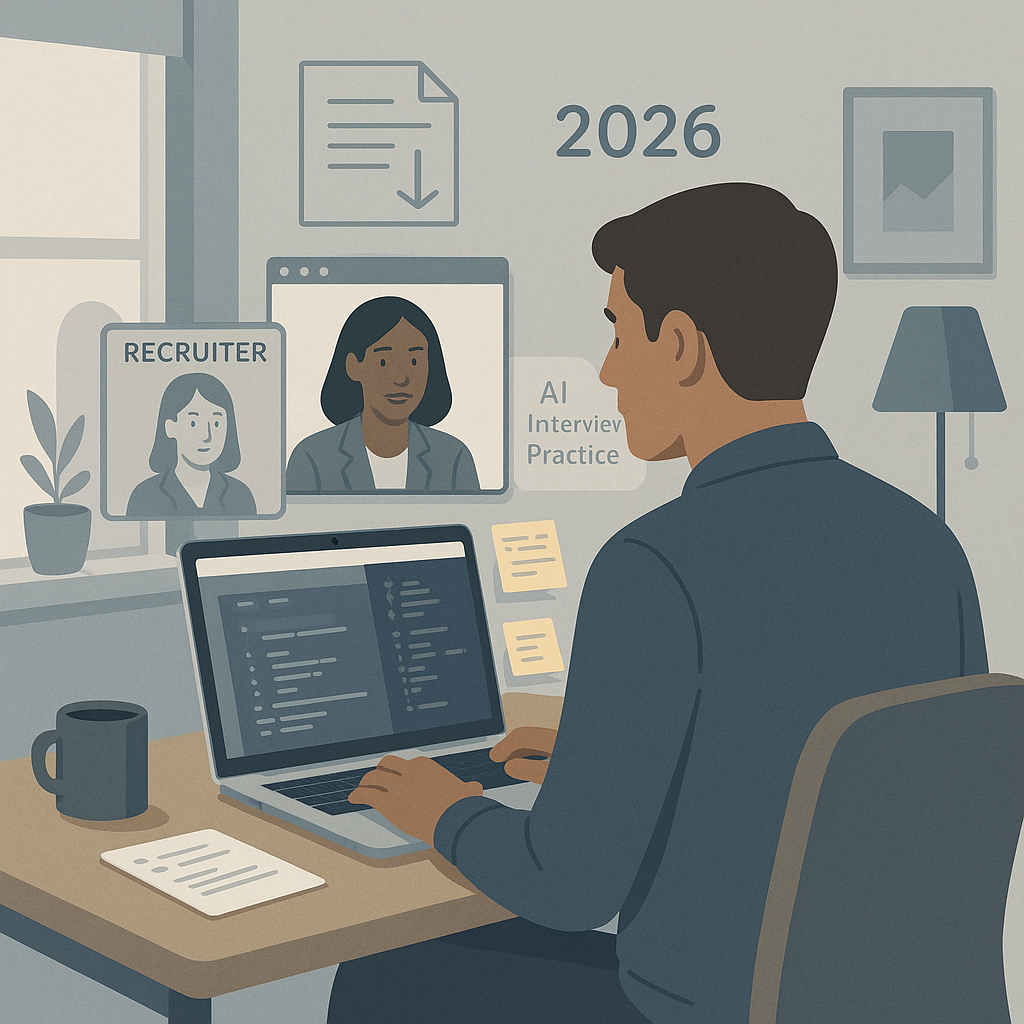
The phrase tech job market 2026 can sound abstract until you look at how people are actually talking about hiring. Not in polished earnings calls or broad labor-market charts, but in the unfiltered places where candidates describe what it feels like to be on the receiving end of a layoff, a recruiter screen, or a six-round process that goes nowhere.
That ground-level view is messy, but useful. In one Reddit post, a frustrated user argued that America’s job market is collapsing. In another, a software worker posted a blunt update: just got laid off. In a third, someone asked why recruiters keep asking why I left my job. None of these posts are formal research. But together they capture something real about the current hiring mood: people feel pressure early, often, and personally.
That pressure changes how technical interviews work.
The hardest part of this market is not just that some companies are hiring less. It is that interviews themselves feel less forgiving. More filters happen earlier. More emphasis is placed on polished communication. More weight lands on explaining transitions, layoffs, and short tenures in a calm way. And when every opening attracts a deeper pool of applicants, small mistakes can carry more consequences.
This is exactly where Nuvis has a credible angle. An AI interview assistant is not valuable because interviewing suddenly became futuristic. It is valuable because the practical demands of interviewing got heavier. Candidates need more realistic practice, more feedback on how they sound, and better preparation for the parts of the process that are easy to underestimate until they cost you a role.
What feels different about the tech job market 2026
There is a version of hiring commentary that treats the market as either healthy or broken. Most candidates know it is not that simple.
Jobs still exist. Recruiters are still active. Companies are still posting openings. But those surface signals can hide a tougher experience underneath. A role may be technically open while still moving slowly, attracting a huge number of applicants, or being scoped so narrowly that only a small slice of candidates can make it through.
That is why many people describe the current environment as exhausting rather than merely competitive.
A few shifts stand out.
More candidates are chasing each open role
When layoffs ripple through the industry, the effect lasts longer than the headlines. Experienced engineers, product managers, analysts, and technical operators do not disappear from the market after one news cycle. They stay in the pool, often applying broadly and competing across levels.
That changes the shape of competition. Mid-level candidates may find themselves up against people with stronger logos on their resumes. Early-career candidates may get screened against applicants with years of experience who are willing to accept roles they would have skipped in a stronger market.
The result is not just “more competition.” It is a tougher baseline for standing out.
Employers are acting more cautiously
In looser hiring periods, some teams are willing to bet on upside. In a tighter cycle, managers often optimize for reduced risk. They want candidates who can sound ready quickly, map cleanly to the role, and create the fewest doubts during interviews.
That caution shows up everywhere: stricter screens, more structured loops, more comparison among finalists, and less patience for rough edges.
Candidates are carrying more uncertainty into the room
A candidate who has been laid off, ghosted, or dragged through multiple broken processes does not walk into the next interview unaffected. Even strong applicants can become over-rehearsed, tentative, or defensive.
You can see that anxiety in the Reddit posts above. One person is venting about the broader market. Another is dealing with the abrupt shock of losing a job. Another is frustrated by a screening question that feels repetitive and loaded. These are different moments, but they point to the same thing: hiring friction accumulates.
And accumulated friction changes performance.
Why technical interviews feel harder even when the formats look familiar
A lot of candidates say some version of this: “The questions are not radically different, but the interviews feel harder.” That is a useful observation.
The difficulty is not always the prompt itself. It is the environment around the prompt.
1. First-round screens matter more than they used to
When applicant volume is high, the early screen becomes more decisive. That means recruiter calls, hiring-manager intros, and short coding rounds can have an outsized impact.
A candidate may only get 20 to 30 minutes to establish competence, clarity, and credibility. If the answer sounds scattered, if the resume story does not line up cleanly, or if communication feels hesitant, there may be no second chance.
That makes the first gate more consequential than many candidates expect.
2. Interviewers are listening for judgment, not just answers
In a crowded market, being technically correct is often not enough. Interviewers also want to hear how you reason, how you handle ambiguity, how you react when you are stuck, and whether you can explain tradeoffs without rambling.
This is one reason people can leave an interview thinking they solved enough of the problem and still get rejected. The missing signal may not be pure technical skill. It may be communication quality under pressure.
3. Employment stories are getting more attention
The Reddit thread about recruiters asking why someone left a job is a good example of a subtle but important shift. In a more cautious market, departure narratives become part of risk assessment.
That does not mean layoffs are inherently stigmatized. Most recruiters know how common they have been. But it does mean candidates are often expected to explain transitions clearly and without drama. If the answer sounds vague, defensive, bitter, or overly long, it can create doubts that have little to do with technical ability.
4. Candidates are interviewing while tired
This is an underappreciated part of the tech job market 2026. Many applicants are not preparing for one ideal process. They are juggling several, often while working, recovering from a layoff, freelancing, or managing financial pressure.
Fatigue changes performance. It affects recall, pacing, confidence, and patience. A candidate who would normally be impressive can sound flat by the fourth interview of the week.
5. The process itself is less trusted
When candidates have seen roles paused, requisitions disappear, or interview loops stretch without clear feedback, they become more transactional. Employers then perceive them as less engaged. Candidates perceive employers as less serious. The interaction gets thinner on both sides.
That trust gap makes interviews feel harsher because every conversation carries more skepticism.
What the Reddit signals actually tell us
It is worth being disciplined here. Three Reddit threads do not define an entire labor market. But they do reveal what candidates are struggling with in real time.
The post about the market “collapsing” is emotionally charged, yet it reflects something common: people are interpreting their hiring experience not as a temporary inconvenience, but as evidence of a broader system that feels unstable.
The post about getting laid off is brief, but its brevity is part of the story. Layoffs often collapse identity, routine, and planning into a single blunt event. The next problem is immediate: how do I get interview-ready again, fast?
The thread about recruiters asking why someone left a role highlights how often friction comes from basic screening conversations, not just high-stakes technical panels. A lot of hiring outcomes are shaped before the candidate even reaches the “hard” interview.
That is the practical takeaway. If you want to understand hiring trends 2026, look at where candidates are losing momentum:
- in the first screen,
- in explaining their background,
- in sounding sharp under fatigue,
- and in adapting to repeated evaluation.
Those are all coachable areas. They are also exactly the areas many candidates neglect because they focus too narrowly on coding drills alone.
Why an AI interview assistant matters in this market
The case for an AI interview assistant is stronger when you stop treating interviews as one isolated test.
Most candidates do not need more generic advice. They need better reps.
They need practice that sounds like a recruiter interrupting them. Practice that forces them to explain a layoff concisely. Practice that exposes where their system design answer becomes too abstract. Practice that reveals when they rush, when they overtalk, and when they stop making sense because nerves take over.
That is the useful role of AI here.
Better practice volume without waiting for live mock interviews
Live mock interviews are helpful, but they are hard to schedule regularly and often expensive. An AI interview assistant gives candidates more attempts, more formats, and more room to repeat weak sections until they improve.
That matters because interview confidence usually comes from repetition, not inspiration.
Feedback on delivery, not just content
Many candidates know the broad shape of a good answer. Fewer know how they actually sound. They do not realize when they bury the key point, hedge too much, skip assumptions, or answer a simple recruiter question with a five-minute speech.
A strong AI interview assistant can help tighten those habits by focusing on structure, pacing, and clarity.
Practice for the awkward parts people underestimate
The current market is full of questions that are not technically hard but are easy to mishandle:
- Why did you leave your last role?
- What happened after the layoff?
- Why this company now?
- Why have you changed jobs more than once in two years?
- Tell me about a time a project went badly.
These are not side quests. In many processes, they are the first real filter. If you sound evasive or disorganized here, your technical skill may never get a proper hearing.
Consistency across a long search
Interviewing well once is useful. Interviewing well over a three-month search is much harder. Candidates lose sharpness, drift off-message, and stop noticing when their answers have become stale or cynical.
An AI interview assistant helps create a repeatable practice loop. That is valuable in a market where stamina matters almost as much as peak performance.
Practical advice for candidates in the tech job market 2026
If you are actively job searching, the goal is not to become slick. It is to become clear, steady, and prepared for predictable friction.
Separate interview skill from job skill
You may be excellent at your work and still interview poorly. Accepting that distinction is useful, not insulting. It lets you train the right thing.
Practice coding, behavioral answers, recruiter screens, and system design as separate skills with separate failure modes.
Fix your transition story before you need it live
If you were laid off, left for personal reasons, or departed a role under stress, write a short version of that story now. Keep it factual and forward-looking.
A solid answer usually covers three points:
- what happened,
- what you did next,
- and what you are targeting now.
You do not need a dramatic narrative. You need a calm one.
Practice out loud, not only in your head
Silent prep makes people feel more prepared than they are. Talk through answers. Record yourself. Use mock interviews. Use an AI interview assistant. Anything that forces your thinking into spoken language will surface problems faster.
Train your opening answer
A surprising amount of interview momentum is decided by the first two minutes. Your self-introduction should be specific, concise, and relevant to the role.
Not a life story. Not a generic summary. A clean positioning statement.
Learn to recover instead of chasing perfection
In this market, candidates often assume one stumble kills the process. Sometimes it does. Often it does not. What matters is whether you can slow down, clarify your assumption, and keep going.
Recovery is a skill. Practice it directly.
Practical advice for employers
Employers are also making this harder than it needs to be.
Stop turning caution into process bloat
Longer loops do not automatically produce better hires. They often produce more noise, more candidate drop-off, and more confusion between polish and actual ability.
Be explicit about what each round is measuring
If one round is about coding fluency and another is about communication, say so. Vague evaluation creates mismatched expectations and lower-quality signal.
Treat layoffs as context, not automatic suspicion
Candidates should not have to perform emotional damage control for broad market events. Ask clean questions. Listen for accountability and clarity, not a perfectly rehearsed redemption arc.
Notice where your screen is filtering out good people
If strong candidates routinely fail at the recruiter stage because they are giving long, anxious, unfocused answers, that tells you something about the pressure your process creates. It may not mean the candidates are weak. It may mean your process rewards a narrow kind of polish.
Where Nuvis fits
Nuvis should not frame this topic like a vague AI revolution. The stronger message is simpler: the tech job market 2026 is making interview performance more important, more variable, and more exhausting.
That creates a real need for better preparation.
Nuvis fits by helping candidates practice the moments that decide outcomes:
- the recruiter screen,
- the technical explanation,
- the behavioral story,
- the layoff narrative,
- the recovery after a mistake,
- and the repetition required to stay sharp over time.
That is a grounded product story. It does not depend on hype. It depends on a plain observation: in a tougher hiring cycle, more qualified people are losing opportunities because they are underprepared for the exact conversation in front of them.
An AI interview assistant cannot fix the market. It can make candidates more ready for the market that exists.
Final thought
The defining feature of the tech job market 2026 is not just fewer easy opportunities. It is that hiring friction now shows up earlier and hits harder. Technical interviews feel tougher because they are carrying more weight, with less room for candidates to warm up, clarify, or recover.
That is why practical preparation matters more than generic advice. Candidates need repeated, realistic practice. Employers need cleaner, fairer evaluation. And Nuvis has a believable place in that gap because it addresses a problem job seekers can feel immediately: knowing the material is not the same thing as delivering it well when the stakes are real.