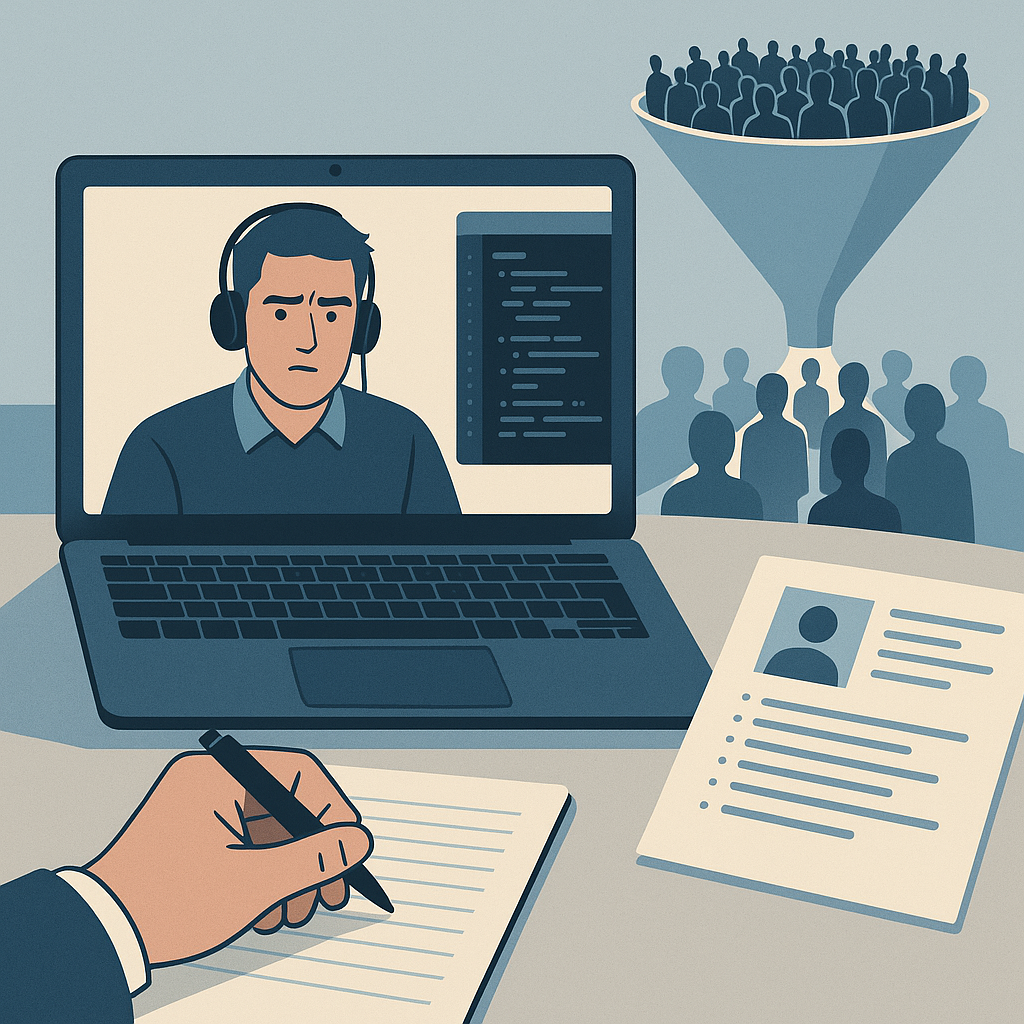
If a lot of interview advice feels out of date right now, that is because it often is.
The biggest shift in 2026 is not just that hiring is slower or that candidates are anxious. It is that many roles now attract a denser concentration of qualified applicants than they did a few years ago. Layoffs have pushed experienced engineers back into the market. Adjacent industries are seeing stronger technical applicants than they used to. Recruiters are screening faster, but not necessarily better. Candidates are feeling all of that in real time.
That changes what technical interview preparation needs to look like.
It is no longer enough to grind a generic set of coding questions and hope the rest works itself out. Candidates need a practical prep plan for the market that actually exists: recruiter screens that eliminate quickly, technical rounds that expect clearer thinking, behavioral interviews that probe for specifics, and processes that vary wildly from company to company.
Public discussions from the past few months capture this mood well. In one Reddit thread, users discuss layoffs at Epic not as a one-off event but as part of a broader pattern of instability in tech hiring (Reddit discussion). In another, a poster working in insurance says “superb talent” is applying there, which is a useful signal that experienced candidates are spilling far beyond traditional tech employers (Reddit discussion). Those threads are anecdotal, not labor-market studies, but they reflect a pattern many candidates and recruiters already recognize: competition is broader, deeper, and harder to read.
For Nuvis, that matters because the product story should match that reality. An AI interview assistant is only compelling if it helps people prepare for the actual points where they lose momentum: the recruiter call, the live coding round, the project deep dive, the vague behavioral question, the system design discussion that drifts because the candidate never practiced saying their reasoning out loud.
The market changed, but most prep advice did not
A lot of interview guidance still assumes a relatively stable environment. It tells candidates to update a resume, review common questions, practice some algorithms, and project confidence. None of that is wrong. It is just incomplete.
In a tighter market, small weaknesses matter more because the comparison set is stronger. You are not only competing with people who are underprepared. You may be competing with engineers who have shipped real systems, senior candidates willing to take a narrower role, or laid-off candidates who are interviewing full time and getting sharper every week.
That does not mean interviews have become fairer or cleaner. In some cases, the opposite is true. Hiring teams under pressure often make messier decisions. Recruiters overload on quick filters. Panels ask overlapping questions. Candidates run into processes that seem designed by committee rather than by actual job requirements.
So the practical question is not “How do I prepare more?” It is “Where does preparation create the most leverage now?”
Usually, it is in four places:
- turning a vague background into a clear story of fit
- practicing live explanation, not just silent problem solving
- preparing for recruiter screens as serious evaluation stages
- building examples with enough detail to survive follow-up questions
That is a more grounded model of technical interview preparation than the usual advice to simply study harder.
Why layoffs matter even if you were not laid off
When people talk about layoffs, they often stop at the headline: fewer jobs, more uncertainty, weaker candidate confidence. But the more immediate hiring effect is compositional. Layoffs change who shows up in the applicant pool.
That is why threads like the Epic discussion matter as signals of market texture, even if they are informal (layoffs thread). When experienced people re-enter the market at once, companies get more resumes with recognizable employers, more applicants with prior interview seasoning, and more candidates who can speak concretely about production systems.
The insurance thread is equally revealing (insurance hiring thread). It suggests something candidates are already discovering: the strongest competition is not confined to a handful of elite software companies anymore. If displaced talent is spreading across sectors, then almost any employer hiring for technical roles may be seeing a more competitive pool.
For candidates, this means three things.
First, “good enough” answers get filtered out earlier. If several applicants can probably do the job, the one with the clearest and most specific answers usually advances.
Second, role fit matters more than broad competence. Recruiters and hiring managers are more willing to choose the candidate who matches the work directly over the candidate who seems capable in the abstract.
Third, your interview performance has to make your experience legible. You may have done strong work, but if you cannot explain what you owned, why decisions were made, and what changed because of your contribution, someone else will look sharper.
That is the real bridge between layoffs and interview prep. The issue is not just scarcity. It is signal competition.
The recruiter screen is now an actual interview
Candidates still underestimate the recruiter screen.
In a market with stronger applicant pools, recruiters often have less reason to “give someone a chance” if the first call is fuzzy. That does not mean recruiters are making perfect decisions. It means they are making faster ones.
A weak recruiter screen usually fails for familiar reasons:
- the candidate gives a long, unfocused background summary
- the target role is unclear
- salary expectations are handled awkwardly
- location, work authorization, or timing issues surface late
- the candidate sounds generic about why they want the role
- the strongest project example is buried under too much setup
None of these are deep technical failures. They are clarity failures.
That is why effective technical interview preparation should include recruiter-stage rehearsal. Candidates should be able to answer, in a crisp way:
- What kind of role are you targeting?
- Why does your background fit this one?
- What have you worked on recently that is relevant?
- What are you looking for next?
- What compensation range are you considering?
- What constraints do you have on timing or location?
The point is not to sound scripted. The point is to stop wasting the first filter.
For Nuvis, this is a useful positioning angle. Most interview tools market themselves around coding rounds because that is easy to explain. But a lot of candidates lose earlier than that. An AI interview assistant that helps people tighten recruiter-call answers, remove rambling, and practice concise role-fit explanations is addressing a real problem.
Stronger pools make vague experience sound weaker than it is
One of the rougher parts of the current market is that solid candidates can sound unimpressive if their examples are too abstract.
Hiring teams hear the same language repeatedly: scaled systems, cross-functional collaboration, performance optimization, stakeholder management, migration work, end-to-end ownership. Much of it is true. But when every resume and every interview uses the same vocabulary, those phrases stop carrying weight on their own.
Candidates need to get more concrete, faster.
Instead of saying:
- “I improved system performance.”
- “I worked on scalable backend services.”
- “I led a migration project.”
They need to say things like:
- what system or service they touched
- what the constraint actually was
- what decision they made
- what tradeoff they accepted
- what metric changed
- what they personally owned versus what the team owned
That is not about using a clever framework. It is about making your work believable.
This is especially important in behavioral and project deep-dive rounds, which are increasingly where candidates separate from one another. A polished coding round may get you through the door. A specific explanation of a difficult incident, architectural disagreement, or migration decision is often what makes you feel senior.
Candidate stress is part of the interview problem
A lot of current hiring frustration is not just about difficulty. It is about unpredictability.
Candidates are dealing with mixed signals: roles that look normal but turn out to have unreasonable expectations, processes that drag on without clear feedback, and job descriptions that seem detached from what the team likely needs. A Recruiting Hell post about a “996” schedule with no benefits is an extreme example, but it captures a kind of employer overreach people are plainly noticing in this market (Recruiting Hell discussion). Another thread, about a disabled candidate being rejected twice despite seeming alignment, reflects the deeper distrust many candidates now feel toward hiring systems that claim to be structured but often do not feel fair in practice (Recruiting Hell discussion).
These posts do not prove that every employer behaves badly. They do show the emotional climate around hiring: candidates expect noise, inconsistency, and sometimes nonsense.
That matters because stress shows up in performance.
Under pressure, candidates:
- answer before understanding the question
- over-explain simple points
- stop narrating their reasoning in coding rounds
- undersell their own contribution out of caution
- sound flatter or less confident than they really are
- forget to ask clarifying questions
This is one place where practice has immediate value. Not because practice removes stress, but because it reduces the amount of cognitive load wasted on format. If you have rehearsed a live coding explanation, a two-minute project summary, and a recruiter answer about compensation, you are less likely to burn energy inventing structure during the interview itself.
That is the practical promise an AI interview assistant should make: not guaranteed outcomes, but faster reps, sharper feedback, and less preventable flailing.
Technical interviews are becoming more about explanation
There is still no single “standard” technical interview, and that inconsistency is part of the difficulty. Some companies still over-index on LeetCode-style problems. Others lean heavily on system design, pair debugging, or project discussion. Many mix several styles without aligning them very well.
The common thread, though, is that explanation matters more than it used to.
Even in coding rounds, interviewers often care less about a perfectly polished answer than about whether the candidate can reason in public. That is partly because employers know candidates have more tools than ever, including coding assistants and AI products. If companies are worried about coached or memorized performance, they naturally put more weight on live thinking, tradeoff discussion, and the ability to recover from mistakes.
That makes silent practice less useful than many candidates think.
You do not just need to solve problems. You need to:
- clarify assumptions out loud
- name tradeoffs
- describe why one path is simpler or safer
- notice edge cases in real time
- recover when an approach does not work
Even a lighthearted post in the LeetCode community about the relief of finally getting something to work hints at how emotionally loaded this part of interview prep remains (LeetCode discussion). Candidates are not simply studying concepts. They are trying to perform problem solving under observation.
That is why mock interviews, spoken walkthroughs, and feedback on clarity are so useful. They train a different skill than solo drilling does.
A practical prep plan for 2026
If the market is stronger and noisier, the best response is not panic-prepping. It is targeted preparation.
A practical 2026 plan looks something like this:
1. Tighten your narrative before you grind more questions
Be able to explain your background in under two minutes. Know which roles you are targeting and why. Have a clean answer for what you have done recently that maps to those roles.
2. Build three strong project stories
Choose examples that show different strengths: ownership, debugging under pressure, technical decision-making, collaboration, migration work, incident response, or tradeoff judgment. Add specifics so they can survive follow-up.
3. Practice recruiter screens separately
Do not treat them as warm-up calls. Rehearse compensation, timing, motivation, location constraints, and concise summaries of fit.
4. Practice coding out loud
Not every day has to be a mock interview, but some of it does. Narration is a skill. So is recovering cleanly when you hit a dead end.
5. Prepare for process variation
One company may ask algorithms. Another may ask debugging. Another may spend 45 minutes on your last project. Prepare for variation instead of assuming every process will resemble the internet’s favorite template.
6. Review fundamentals through your real work
If you are studying system design, tie it back to systems you have touched. If you are reviewing databases or concurrency, anchor them in concrete examples. Interview answers get better when they connect concept to actual experience.
This is the kind of prep structure Nuvis should speak to directly. Not vague confidence-building. Not hype about AI. Useful repetition in the places where candidates actually break down.
Where Nuvis fits
Nuvis has a strong angle here if it stays concrete.
The pitch is not that interviews are hard. Everyone knows that.
The pitch is that technical interview preparation in 2026 has become more fragmented and more performance-driven. Candidates need help practicing the parts that matter now: recruiter screens, live technical explanation, behavioral specificity, and role-relevant repetition under time pressure.
An AI interview assistant makes sense in that context if it does a few things well:
- simulates realistic interview prompts instead of generic trivia
- helps candidates tighten long or muddy answers
- gives fast feedback on clarity, structure, and specificity
- supports recruiter, technical, and behavioral stages rather than just coding
- encourages practice that improves thinking instead of masking weak thinking
That is a credible product story because it matches what candidates are experiencing. The market does not need more magic promises. It needs tools that help people communicate competence more clearly in a crowded field.
The bottom line
The 2026 hiring market has changed the practical meaning of interview prep. Layoffs have added experienced candidates back into circulation. Stronger applicant pools have made weak signals easier to ignore. Recruiter screens matter more. Specificity matters more. Live explanation matters more. And the emotional drag of an uneven hiring environment is affecting how people perform.
So technical interview preparation now has to be more deliberate than generic. Candidates need sharper stories, more realistic rehearsal, and practice that reflects actual interview pressure rather than idealized advice.
That is also the opening for Nuvis. If it positions itself as an AI interview assistant for the real bottlenecks of 2026 hiring, not as a shortcut machine, the value proposition becomes much clearer: help candidates think better, answer better, and waste fewer shots in a market that is not very forgiving.