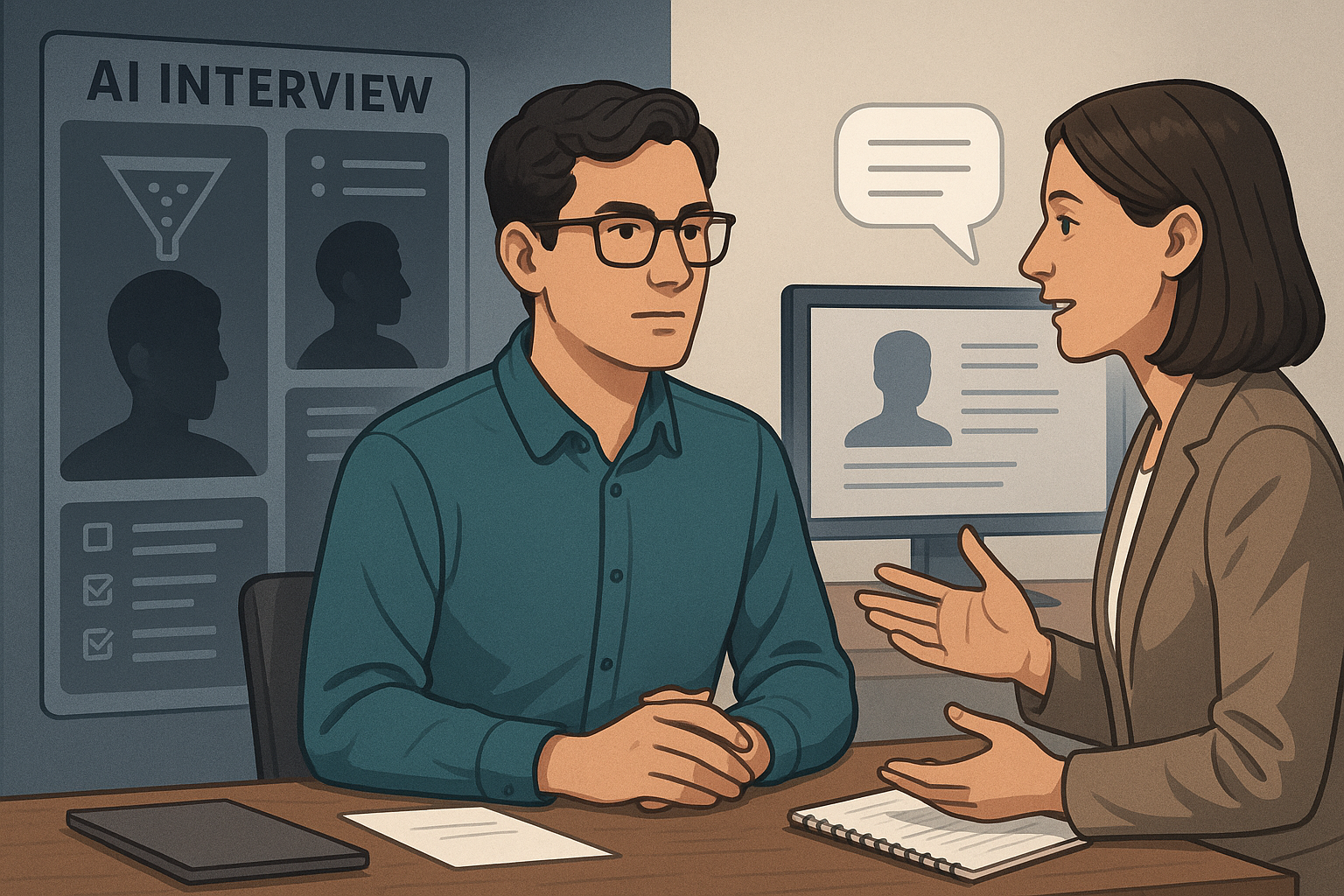
The mood around AI in hiring has changed.
A year ago, a lot of the conversation was still framed around speed: faster sourcing, faster screening, faster prep, faster applications. In 2026, the more revealing question is whether any of that speed is actually improving hiring outcomes for candidates or employers. Across public forums, the answer looks mixed at best.
Candidates are describing hiring pipelines that feel opaque and impersonal. Recruiters are dealing with more volume and noisier signal. Technical candidates are still struggling with live interviews, especially when anxiety scrambles recall. And at the same time, there is rising skepticism toward AI tools that make people sound polished without making them meaningfully better.
That shift matters for anyone building an AI interview assistant.
The market is not simply asking for more AI. It is getting more selective about what kind of AI feels useful, honest, and worth trusting. For Nuvis, that is not a threat. It is the opportunity. If blind hiring automation is losing goodwill, then the tools that stand out will be the ones that help candidates practice clearly, think under pressure, and show their reasoning without pretending to replace it.
The backlash is not abstract anymore
It is easy to talk about “AI fatigue” in vague terms. What is more useful is to look at what candidates are actually saying.
In one recent Reddit thread on r/recruitinghell, a poster described frustration with how tech companies filter out applicants before a meaningful human review, capturing a feeling many job seekers recognize: the process is optimized for throughput, but not necessarily for judgment or fairness (r/recruitinghell discussion). Another thread in the same community used the phrase “AI dystopia” to describe the broader experience of being pushed through heavily automated hiring steps that feel detached from the person on the other side (r/recruitinghell thread).
You do not have to accept every complaint at face value to see the pattern. People are increasingly sensitive to systems that save labor for companies while shifting confusion and stress onto candidates.
There is a second thread running alongside that one: anxiety about overreliance on AI itself. A recent discussion on r/OpenAI reacting to an alarming study about people simply doing what AI says speaks to a broader concern that these tools can flatten judgment instead of sharpening it (r/OpenAI discussion). In hiring, that concern lands hard. Interviews are still one of the few places where a candidate has to demonstrate live reasoning, not just submit polished materials.
Taken together, these conversations point to a practical market reality. Candidates are frustrated with blind hiring automation, but they are also wary of AI products that encourage shortcut behavior. That combination raises the bar for any AI interview assistant that wants to be taken seriously.
Why technical interviews expose weak AI help so quickly
Technical interviews are where shallow assistance tends to break.
A candidate can use a model to generate a neat explanation of a caching tradeoff, produce a tidy behavioral answer, or outline a likely coding approach. But actual interviews are unstable by design. The interviewer changes the prompt. A constraint appears halfway through. A follow-up question tests whether the candidate understood the tradeoff or just repeated it. The room gets quiet. The candidate starts rushing.
That is why the real problem is often not lack of information. It is failure under pressure.
A recent post on r/leetcode about anxiety and brain freeze during interviews puts this plainly: many candidates do know the material, but they struggle to retrieve it and communicate it coherently in the moment (r/leetcode discussion). Anyone who has been through technical interviewing knows how common this is. The candidate is not always underprepared. Sometimes they are overloaded, over-rehearsed, or unable to recover once the conversation goes off script.
That is where a lot of AI interview products miss the mark. They assume the main bottleneck is generating better answers. In reality, the bottleneck is often one of these:
- structuring an answer under time pressure,
- thinking aloud without rambling,
- recovering after a mistake,
- explaining tradeoffs in plain language,
- or staying composed when the interviewer interrupts the original plan.
A credible AI interview assistant should be designed around those moments, because those are the moments that decide technical interviews.
The practical shift from answer machine to thinking partner
This is where the category is starting to split.
One kind of product acts like an answer machine. It helps users produce polished output fast. That can feel useful in the short term, especially when a candidate is juggling multiple applications and trying to prep quickly. But the tradeoff is obvious: if the tool does too much of the thinking, the candidate has less practice doing the thinking themselves.
The other kind of product acts more like a structured thinking partner. It helps candidates rehearse, reflect, tighten explanations, and identify reasoning gaps. It does not remove the work. It makes the work more focused.
That distinction sounds subtle, but it changes everything.
A good AI interview assistant should help a user answer questions like:
- What assumption did I skip?
- Where did my explanation lose structure?
- Did I compare alternatives clearly enough?
- Did I actually answer the question, or drift into memorized prep?
- What happens to my communication quality when I am under a timer?
Those are not vanity metrics. They are exactly the things interviewers notice.
For Nuvis, this matters because the winning position in 2026 is not “we generate the most content.” That is an easy claim to copy, and it is getting less persuasive. The stronger position is: we help candidates become more legible, more prepared, and more credible in live interviews.
What candidates actually need help with now
The easiest way to make this discussion concrete is to focus on failure points that show up repeatedly in technical interviewing.
1. Turning preparation into recall
A lot of candidates study correctly and still freeze. They know the algorithm, but cannot retrieve it fast enough. They know the system design pattern, but cannot explain why they chose it. They have prepared behavioral stories, but under pressure they tell them out of order.
This is where an AI interview assistant can add real value if it simulates retrieval instead of just supplying material. The useful intervention is not another perfect sample answer. It is repeated practice at recalling, organizing, and defending an answer from memory.
2. Making reasoning visible
Many candidates are stronger than they sound. Their problem is not intelligence; it is legibility.
They jump into code before clarifying constraints. They mention a data structure but not why it fits. They arrive at the right answer too quickly and accidentally hide the reasoning that got them there. Interviewers are then left guessing whether the candidate really understands the tradeoffs.
Useful coaching helps candidates slow down just enough to make their thought process visible. That is one of the most practical forms of critical thinking in interviews: not abstract brilliance, but disciplined explanation.
3. Handling interruptions and ambiguity
Real interviews are not clean scripts. Requirements shift. Interviewers interrupt. A “simple” coding round turns into a discussion about edge cases, memory constraints, or production tradeoffs.
Tools that only optimize for prepared monologues are brittle. Tools that introduce ambiguity, time pressure, and follow-up questions are much closer to the real thing. That kind of practice builds adaptability, which is often what separates a candidate who looks prepared on paper from one who feels solid in conversation.
4. Managing technical interview anxiety without pretending it does not exist
This is one place where generic interview advice usually falls apart. Telling candidates to “be confident” is not useful. Anxiety is not a branding problem. It changes recall, pacing, and speech.
A stronger product approach is to help candidates normalize that pressure and train through it. For example: shorter timed rounds, follow-up drills after a wrong answer, post-session breakdowns of where the candidate sped up or lost clarity, and repetition that builds familiarity with discomfort. That is how an AI interview assistant can genuinely support technical interview anxiety rather than just gesture at it.
Why blind hiring automation makes this more important, not less
There is an irony here.
The more automated hiring becomes, the more valuable authentic signal becomes. If employers are filtering harder and candidates are optimizing harder, everyone has a stronger incentive to look polished. But polished is not the same as prepared.
That tension shows up in candidate communities all the time. Ongoing threads like the March 30, 2026 interview discussion on r/cscareerquestions reflect just how actively candidates compare process quality, expectations, and fairness in real time (r/cscareerquestions thread). When hiring feels opaque, people look for ways to decode or game it. That is understandable. It is also part of what makes the system worse.
Employers end up seeing more optimized applications and less trustworthy signal. Candidates feel pressured to automate because they assume everyone else is doing it. Recruiters then add more filters to handle the flood. The cycle feeds itself.
An AI interview assistant cannot solve all of that. But it can choose whether to make the cycle worse or better.
A tool that helps candidates mass-produce surface polish contributes to the noise. A tool that helps them think more clearly in live interviews improves the quality of signal that emerges later in the process. That is a smaller promise, but it is a more durable one.
What a stronger Nuvis angle looks like
If this article were just “AI in hiring is controversial,” it would not be especially useful. The more practical point is that Nuvis can benefit from this market shift by being explicit about what kind of help it offers.
The opportunity is to position Nuvis as the AI interview assistant for candidates who want to prepare honestly and perform better in the room.
That means emphasizing product behavior such as:
- realistic mock interviews instead of generic output generation,
- feedback on structure, tradeoffs, and clarity,
- drills that expose reasoning gaps,
- support for recovering from mistakes mid-answer,
- and practice that addresses technical interview anxiety directly.
It also means being careful with messaging. Candidates are already suspicious of products that imply they can bypass the hard part. Recruiters and hiring managers are increasingly skeptical of answers that sound polished but strangely weightless. So the strongest brand voice here is a restrained one: Nuvis helps you practice, sharpen, and communicate. It does not pretend to interview in your place.
That is a better fit for the moment because trust is now part of the product.
The standard for an AI interview assistant in 2026
In 2026, a serious AI interview assistant should probably be judged against a fairly simple standard: does it make the candidate more capable when the script breaks?
That is the real test.
Not whether it can generate a cleaner answer in a text box. Not whether it can produce a perfect framework on command. But whether the candidate becomes better at clarifying questions, making tradeoffs explicit, speaking coherently under stress, and adjusting when the interviewer changes direction.
That is the kind of help candidates increasingly seem to want. It is also the kind of help employers should prefer, because it produces stronger signal than automation theater.
The backlash against blind hiring automation is therefore not just a complaint cycle. It is a sorting mechanism. It is pushing weak, low-trust uses of AI into clearer view and creating space for products that support real preparation.
For Nuvis, the implication is straightforward. The product does not need to win by doing more thinking for the candidate. It can win by helping the candidate do better thinking themselves.
Bottom line
The market for interview tools is getting stricter, not smaller.
Candidates are frustrated with opaque filters and dehumanized hiring flows. They are also becoming more alert to AI products that flatten judgment, encourage dependency, or confuse polish with readiness. In technical hiring especially, those shortcuts are hard to hide once the conversation becomes live, adaptive, and stressful.
That is why the bar for an AI interview assistant is rising in 2026. The useful products will be the ones that improve recall, structure, communication, and composure under pressure. They will help candidates practice critical thinking in interviews, not just manufacture cleaner-sounding answers. And they will treat trust as part of the job, not a marketing extra.
For Nuvis, that is a practical and credible position: build for the candidate who wants to show up sharper, calmer, and more convincing when it counts.