Hiring backlash isn’t a vague “candidate experience” trend anymore—it’s people documenting specific process failures in public and warning others away. When candidates can point to inconsistent interview questions, shifting role expectations, inaccessible processes, or recruiter outreach that seems detached from basic reality, trust collapses fast.
If you want a concrete snapshot of what candidates are reacting to, read a few threads that are circulating widely:
- A disabled candidate describing being rejected twice despite believing they met the job’s needs—raising questions about accessibility, consistency, and how decisions get made: r/recruitinghell
- A recruiter pitching a “996” schedule with no benefits—an example of role scoping and respect breaking down before an interview even starts: r/recruitinghell
- Engineers processing yet another layoff wave and what it does to morale, mobility, and the meaning of “career stability”: r/cscareerquestions
- A candidate spiraling after rejection from a top-tier company—an extreme reaction, but one that reflects how opaque, high-friction technical hiring can feel: r/leetcode
Those aren’t academic studies, and they’re not “the whole market.” But they’re useful because they show the same failure modes repeatedly:
- Interviewers asking whatever they feel like
- Rubrics that exist on paper but aren’t used in the room
- Decisions made from vibes and memory instead of evidence
- Accommodation requests treated as exceptions (or ignored)
- Recruiter outreach that misrepresents the role or its constraints
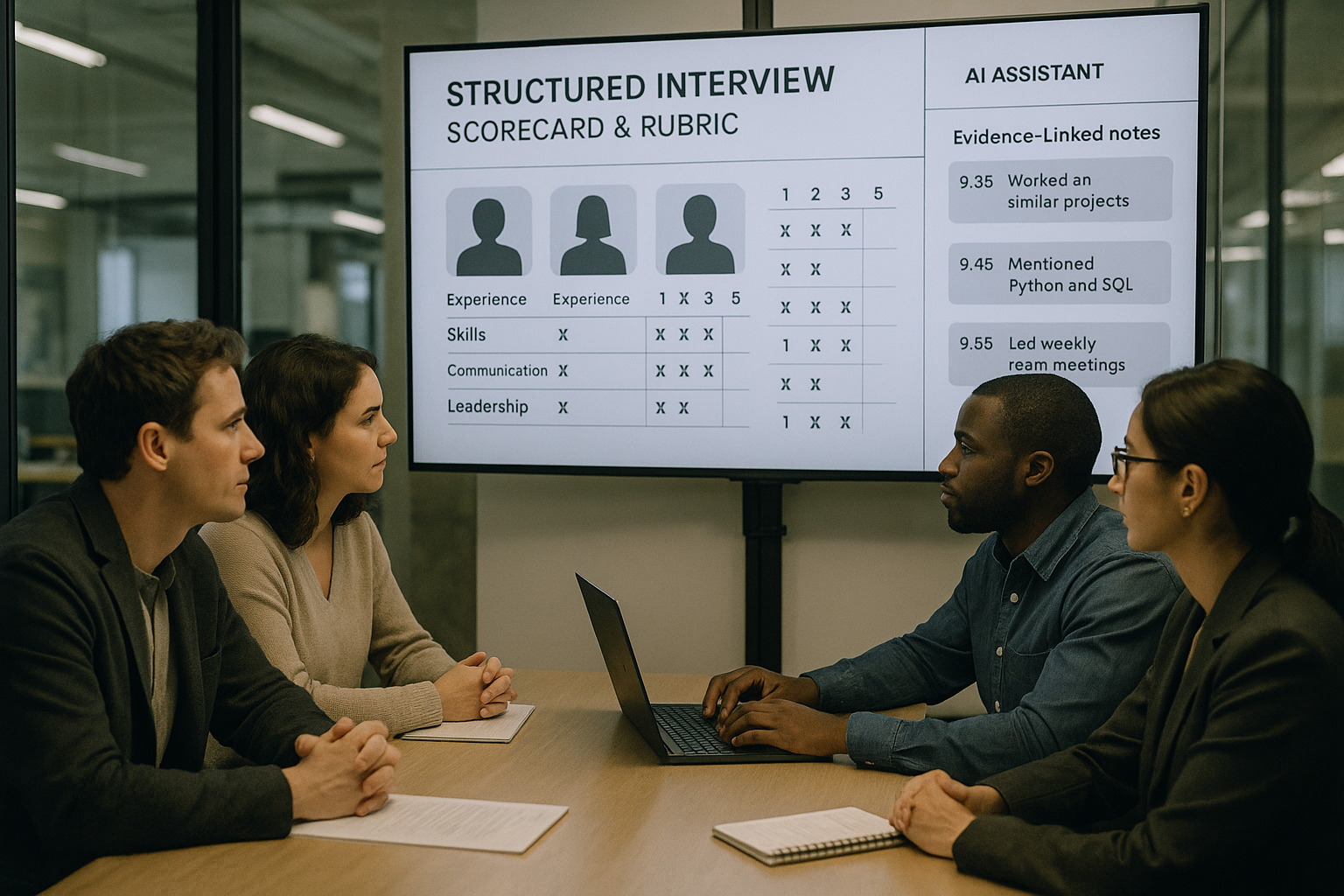
Nuvis’s angle is simple: you don’t fix this by adding another round or buying another tool. You fix it by making interviews structured, evidence-based, and auditable—and using an AI interview assistant as the consistency layer (note capture, rubric alignment, and decision traceability), not as a replacement for human judgment.
What “broken hiring” looks like in practice (and why candidates call it out)
A lot of hiring teams would say they already have a process: a recruiter screen, a technical screen, a loop, a debrief. The problem is that many of those steps are performative structure—they look standardized from the outside but behave like improvisation on the inside.
Here’s what candidates notice immediately.
1) The interview is “structured” only in the calendar invite
If each interviewer brings their own pet question, their own definition of seniority, and their own scoring style, the outcome is highly sensitive to who you happened to get that day.
Candidates experience this as randomness: one interviewer wants algorithm trivia, another wants system design, another wants “culture fit,” and no one seems to share a definition of what the role actually needs.
2) The role changes mid-process
Sometimes the job description is aspirational. Sometimes the hiring manager is still figuring out the actual scope. Sometimes recruiting is staffed to hit pipeline targets and the intake is thin.
The “996, no benefits” outreach story is a loud example of the same underlying issue: outreach and evaluation can’t be credible if the role is poorly scoped or sold without realism and respect (source).
3) Accessibility is treated as a special request, not a default capability
Even teams with good intentions can fail here. The candidate isn’t asking for a favor; they’re asking for a fair shot at demonstrating the same competencies.
When a disabled candidate says they were rejected twice despite meeting the job’s needs, you can’t diagnose the situation from a thread—but you can take the lesson: if you can’t show that accommodations were offered, applied consistently, and separated from performance evaluation, you’re creating avoidable distrust (and risk) (source).
4) Technical hiring becomes an endurance test with unclear signals
High-friction technical loops can push candidates into a “study for months, get rejected, learn nothing” cycle. That’s how you end up with posts like “I wasted my life.” The emotion is intense, but the complaint underneath is legible: high effort, low transparency, little evidence that the process measured job-relevant skills (source).
5) Market volatility makes everything feel colder
Layoffs don’t just change supply and demand. They change how people interpret silence, delays, and scripted rejection notes. A process that might have felt “fine” in a hot market feels careless in a cold one—especially when candidates are already rattled and comparing notes (source).
The fix isn’t more hoops. It’s an auditable interview system.
When candidates say they want “fairness,” they’re usually asking for two concrete things:
- Consistency (people are evaluated against the same criteria)
- Legibility (the company can explain the decision internally based on evidence)
That’s what auditable structured interviews are for.
“Auditable” doesn’t mean “we store the notes somewhere.” It means you can answer, later, in a real debrief or an internal review:
- What competencies did we assess?
- What did we ask to assess them?
- What counts as meets / exceeds / below bar?
- What evidence supports the score?
- Were accommodations requested, provided, and documented?
- Did any interviewer deviate from the plan, and did that affect scoring?
An AI interview assistant can make this easier, but only if the human system is sound. Without structure, AI just produces cleaner-looking chaos.
What an AI interview assistant should do (and what it should never do)
Used well, an AI interview assistant is mostly a consistency and documentation tool.
What it should do
- Enforce interview templates: keep interviewers inside a defined question set per role/level.
- Capture evidence: timestamped notes, candidate statements, key decisions, and (where appropriate) code snippets or artifacts.
- Map evidence to rubric criteria: not “smart vibes,” but explicit connections to pre-written competencies.
- Make debriefs less subjective: pull up the same evidence for everyone during decision-making.
What it should not do
- Invent reasons: if the evidence isn’t present, the summary should say “not observed.”
- Hide scoring logic: any scoring assistance must be transparent and editable.
- Replace accommodations: if the process can’t flex for candidates, AI won’t save it.
Nuvis’s north star here is not automation for its own sake. It’s making interviews repeatable.
The practical playbook: rebuild trust in 45 days
This is intentionally operational. You can run it with a small working group: recruiting ops (or whoever owns process), the hiring manager, and 3–5 regular interviewers.
Days 1–7: Write the scorecard you actually hire to
Deliverable: a one-page scorecard per role/level.
Keep it tight:
- Success outcomes at 3 months and 12 months
- 5–7 competencies max
- What evidence counts for each competency
- Explicit non-signals (e.g., pedigree proxies, “confidence,” or irrelevant trivia)
Example competency set for many software roles:
- Problem decomposition
- Debugging & testing discipline
- Code quality & tradeoff reasoning
- Systems thinking (for senior roles)
- Communication (clarity, not charisma)
- Collaboration (working through disagreement)
If the scorecard is vague, everything downstream becomes political.
Days 8–17: Build structured interviews (question bank + anchored rubric)
Deliverables:
- A stage plan (screen → technical → loop → HM)
- A question bank tagged by competency and difficulty
- A rubric with anchored examples
Anchors are the difference between “structured” and “we checked a box.” Here’s an anchored rubric example that interviewers can actually use.
Competency: Debugging & Testing
- Below bar: guesses repeatedly, doesn’t isolate variables, can’t explain why a test is useful
- Meets bar: forms a hypothesis, designs targeted tests, checks edge cases, explains reasoning
- Exceeds bar: anticipates failure modes, uses instrumentation, proposes monitoring/alerts, communicates tradeoffs
Write anchors in observable language. If it can’t be observed in an interview, it’s not an anchor.
Days 18–28: Add the AI interview assistant as “evidence capture + rubric alignment”
Deliverables:
- Interview templates in the tool mapped to your scorecard
- Candidate consent language (simple and plain)
- A reviewer workflow: who checks summaries, when, and how corrections are made
Guardrails worth enforcing on day one
- Rubric-first: the rubric must exist before the tool is turned on.
- Evidence-linking: summaries must cite what was asked and what was answered.
- No mystery scoring: if the tool suggests a score, show the justification and require human confirmation.
- Accommodations are part of the workflow: the template should prompt interviewers to confirm accommodations were offered and applied.
Days 29–35: Train interviewers and run calibration (don’t skip this)
You don’t need a 12-hour training program. You need one solid session and a recurring calibration habit.
One 60-minute session should cover:
- How to ask structured questions without leading
- How to take evidence-based notes
- How to use the anchored rubric
- How to avoid “halo/horns” effects and pedigree shortcuts
Calibration exercise (30 minutes):
- Everyone scores the same two sample responses
- Compare variance
- Discuss what “meets bar” means with reference to anchors
- Update anchors if necessary
This is where consistency is created. Tools don’t do it for you.
Days 36–45: Launch, measure, and tighten the loop
Deliverable: a lightweight dashboard that answers:
- Time-to-schedule per stage
- Drop-off rate per stage
- Interviewer scoring variance
- Pass-through rates by stage
- Candidate feedback signals (even a 1–2 question survey)
If you can’t see where the process is leaking trust, you’ll argue about anecdotes forever.
Small changes that immediately reduce backlash
You can fix a surprising amount without adding headcount.
- Publish “what to expect” for the interview loop (by role family).
- Send prep that matches reality (topics + format + how it’s evaluated).
- Set a response SLA (and meet it).
- Stop defaulting to extra rounds. Add a round only when it measures a distinct competency.
- Make accommodations routine: one clear channel, fast response, no friction.
Candidates don’t need you to be perfect. They need you to be coherent.
How this addresses the exact pain candidates describe
- “It felt arbitrary.” → Consistent questions + anchored rubrics + calibration reduce interviewer roulette.
- “They moved the goalposts.” → Scorecards lock competencies; templates keep interviewers aligned.
- “I don’t think it was fair.” → Evidence-based notes and an audit trail make decisions reviewable.
- “The recruiter sold me something unreal.” → Better intake + role scorecard prevents misaligned outreach.
- “I put in massive effort and got nothing.” → Clear expectations and job-relevant assessments reduce wasted prep.
The goal is not to eliminate rejection. The goal is to eliminate the sense that the outcome depended on randomness, inconsistency, or a process nobody can explain.
Bottom line
In 2026, broken hiring isn’t just inefficient—it’s publicly visible. Candidates are sharing the receipts, and the stories that spread fastest are the ones where the process looks careless, inconsistent, or inaccessible.
The most reliable way to rebuild trust is to treat hiring like an operational system: structured interviews, anchored rubrics, calibration, and an auditable trail of evidence. An AI interview assistant earns its keep when it reinforces that system—capturing what happened, mapping it to the rubric, and making debriefs about evidence instead of vibes.