Hiring has a trust problem—and not the abstract, “employer brand” kind. It’s the day-to-day, candidate-level suspicion that the process is either (a) trying to extract free labor, (b) hiding the real criteria, or (c) wasting time because nobody internally agrees on what “good” looks like.
That suspicion isn’t new. What’s new is how visible it has become. A single screenshot, a single weird recruiter message, or a single rejection story can travel through Slack groups, group chats, and Reddit in a day. And candidates increasingly assume your process will look like the worst examples they’ve seen online—until you prove otherwise.
Three recent threads in r/recruitinghell capture the mood clearly:
- A story about being rejected twice and the emotional toll—especially when disability context feels ignored or mishandled: “disabled man rejected from job twice…”
- A recruiter pitching a job with “996” hours and no benefits as if it’s normal: “996, no benefits…”
- A thread that lands because it’s funny and bleak at the same time: “I want to laugh but the situation is too real”
You don’t have to treat Reddit as a representative sample of all hiring. You do have to treat it as a public record of the experiences candidates remember and share.
At the same time, many teams are rolling out an AI interview assistant to summarize calls, draft feedback, suggest follow-ups, and standardize debriefs—often starting with technical interviews because that’s where time gets burned.
Here’s the tension for 2026: AI can make interviewing more consistent and more documented, which should improve trust. But if you deploy it like a black box—“the system scored you”—AI becomes one more reason candidates believe the process is opaque and unfair.
This article is a practical playbook: what those viral posts reveal about candidate distrust, and what to do differently when you introduce an AI interview assistant (including how Nuvis should be positioned: not as automation, but as auditability + structure).
What those viral posts are actually signaling
The details vary, but the themes rhyme. When a post blows up, it usually contains at least two of these ingredients:
- A power imbalance on display. Candidates feel like they have to accept whatever is put in front of them—another round, another test, another “quick task.”
- Ambiguity. The criteria are unclear, feedback is vague, and decisions feel arbitrary.
- Normalization of bad norms. “This is just how it is” (extreme hours, no benefits, endless hoops) is presented as reasonable.
Even when the employer in the story is uniquely bad, readers don’t interpret it as “one bad company.” They interpret it as “this could happen to me again.” That becomes the baseline mood a candidate brings into your first call.
Candidate distrust in 2026 looks like behavior, not vibes
If you’re running a funnel, distrust shows up in measurable places:
- Reply rates drop (especially among candidates with options).
- More ghosting after a take-home or after a “just one more round” request.
- Shorter, guarded interview answers (candidates stop volunteering details that could be misread).
- Hard boundaries on effort (“no unpaid assignments,” “no weekend take-home,” “no recorded interviews”).
- Public or semi-public feedback loops—Reddit, Blind, Discords, niche communities—where process issues get documented.
That matters for AI adoption because AI tools often touch the most sensitive moments: transcription, summaries, scoring suggestions, or standardized feedback. Those moments are where candidates are already primed to ask: “Who is actually listening to me?”
The trust trap: “AI makes us efficient” can sound like “we don’t care”
Most teams buy an AI interview assistant for understandable reasons:
- interviewers are tired of writing notes
- debriefs are inconsistent
- hiring managers want “data” but don’t want admin work
- recruiters want fewer bottlenecks
But candidates don’t experience your internal pain. They experience your process. If the roll-out is sloppy, “efficiency” reads as impersonality.
In a distrustful climate, candidates immediately wonder:
- Was I evaluated by a person or a model?
- What exactly did you store about me?
- Did the system misunderstand my communication style?
- Did anyone review the output, or did the tool quietly decide?
If your team can’t answer those questions plainly, the AI interview assistant becomes the villain in the story—whether or not it actually caused the decision.
The practical fix: make AI increase accountability, not mystery
The right framing for 2026 is simple:
Use AI to make the process more structured, more consistent, and more explainable.
That means treating the AI interview assistant like an instrument panel—not an autopilot.
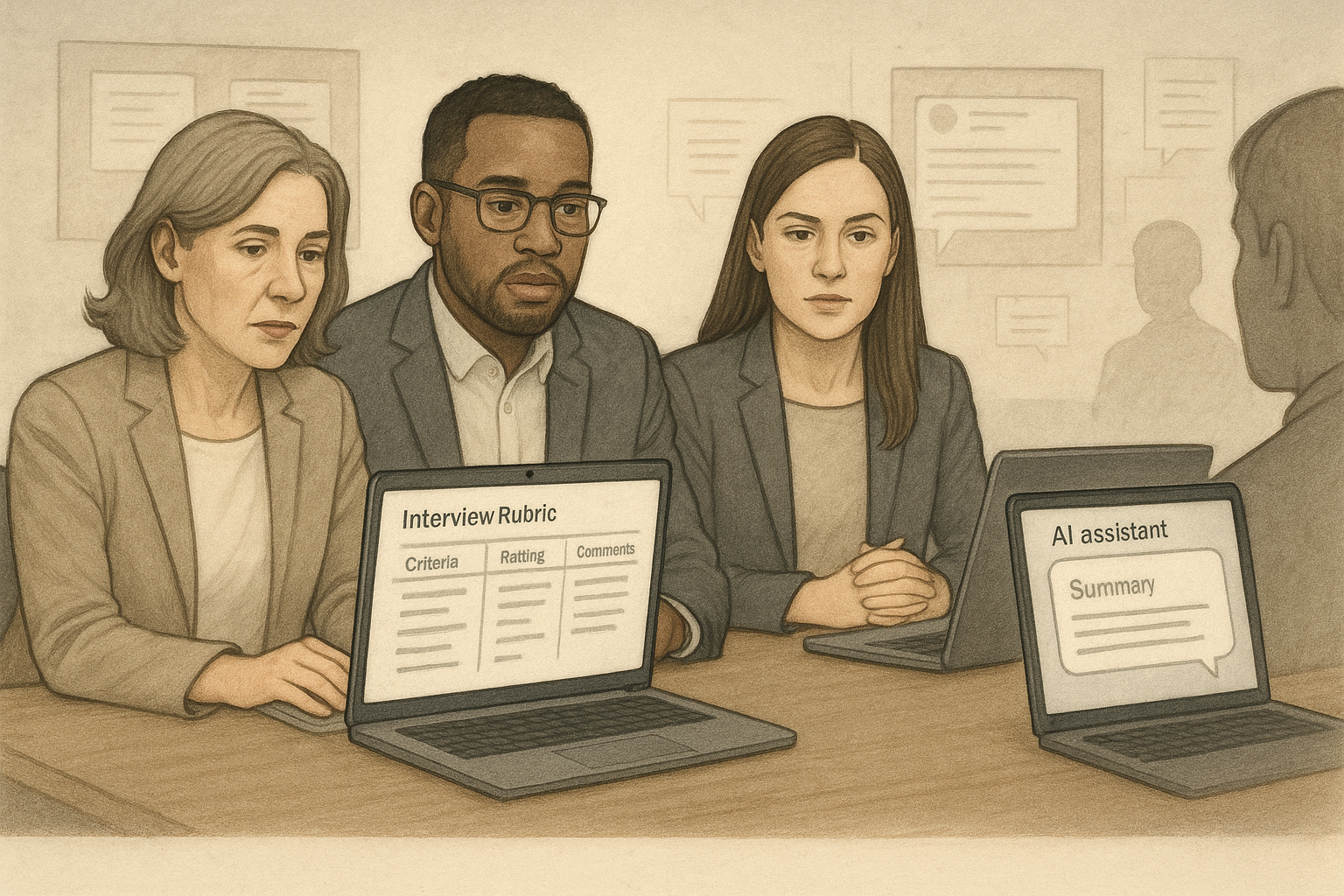
Nuvis’s most defensible angle here is “hire with receipts”: structured interviews, clear rubrics, and an audit trail that shows how decisions were made.
What “auditable” should mean in a real hiring workflow
Not a manifesto. Not a 12-page policy. Actual operational questions your team can answer:
- What inputs did the AI see (transcript, notes, rubric, job description)?
- What did it produce (summary, evidence mapping, draft feedback)?
- What did a human edit, approve, or override?
- Where is the evidence for a given score (quotes, moments, examples)?
- Who had access, and what’s the retention period?
If you can’t answer those, don’t pretend “trustworthy AI” is a feature. Build the system so you can answer.
Four trust pillars for adopting an AI interview assistant (specific, not fluffy)
1) Candidate-facing transparency (the one-paragraph version)
Candidates don’t need legalese. They need a short explanation before the interview.
Use language like:
“We use an AI interview assistant to help take notes and organize feedback against a role rubric. Interviewers make the decision. We review AI-generated notes for accuracy, and we don’t use automated tools to make final hiring decisions.”
Then include the basics:
- whether the interview is recorded/transcribed
- what is stored and for how long
- who can access it
- whether an opt-out exists (and if not, why)
Surprise is what triggers distrust. A clear heads-up prevents the “gotcha” feeling.
2) Structured interviews that remove randomness (especially in technical interviews)
Candidates hate feeling like they got a “hard interviewer” while someone else got a friendly one. Structure is how you avoid that.
At minimum, define:
- the competencies you’re evaluating (e.g., debugging, system design, communication)
- which round covers which competencies
- a rubric with anchored definitions (what “3/5” actually means)
- required evidence (examples, tradeoffs, reasoning—not vibes)
Where an AI interview assistant helps is in enforcing consistency:
- prompting interviewers to cover missing competencies
- mapping notes to the rubric categories
- generating a debrief template that forces specificity
The goal isn’t to “score candidates with AI.” The goal is to prevent the common failure mode of modern hiring: everyone remembers the interview differently, and the loudest opinion wins.
3) Time boundaries that prove you’re not extracting free labor
The fastest way to lose trust is an assignment that looks like real work with no guardrails.
If you must use take-homes:
- cap them (60–90 minutes is a reasonable ceiling for many roles)
- state exactly what you’re evaluating
- state what “good” looks like
- commit to a decision timeline
- avoid tasks that resemble a deliverable your team could ship
Better yet, replace sprawling take-homes with:
- time-boxed work samples
- pair-debug sessions using toy problems
- portfolio walkthroughs with targeted questions
This is where the “996 / no benefits” vibe in viral posts becomes relevant even to normal companies. Candidates don’t only fear bad jobs; they fear employers who casually disregard their time. Your process should actively demonstrate the opposite.
4) Human ownership of decisions (and visible review of AI output)
If you want candidates—and your own interviewers—to trust the system, create a simple rule:
- AI can draft.
- Humans must review, edit, and sign.
Operationally, that means:
- every debrief shows the human reviewer
- edits/overrides are tracked (even lightweight)
- final recommendations reference evidence, not “the tool said”
This protects candidates and your organization. When someone challenges a decision, you have an accountable chain of reasoning.
How to talk about AI in interviews without lighting the fuse
What not to do in 2026:
- “We use AI to score candidates.”
- “It’s more objective.”
- “Don’t worry about it.”
Those lines trigger exactly the distrust you’re trying to avoid.
What to do instead: explain the boundary.
- “It helps with notes and consistency.”
- “It maps evidence to our rubric so we don’t miss anything.”
- “Interviewers make the decision, and we review the notes for accuracy.”
Candidates are rarely demanding perfection. They’re demanding that the process be legible.
A concrete pre-launch checklist for recruiting teams
If you’re rolling out an AI interview assistant this quarter, treat this as your “go/no-go” list.
Process readiness
- We can name the competencies for each role family.
- Each interview round has a purpose and is not redundant.
- Rubrics exist and interviewers understand how to use them.
- We have a plan for take-homes (or a plan to avoid them).
Candidate communication
- We disclose AI usage in the invite.
- We can explain what is captured, stored, and retained.
- We can answer “Is this making the decision?” with an honest, simple “no.”
Governance and audit
- Access control is defined (who can view transcripts/recordings).
- Human review is required before feedback enters the hiring record.
- We can export or reconstruct the reasoning behind a decision.
Calibration
- We periodically check interviewer variance.
- We review outcomes for patterns that suggest bias or inconsistent bars.
This is the place for Nuvis to be opinionated: good AI in hiring isn’t the cleverest model—it’s the clearest, most reviewable workflow.
Why r/recruitinghell matters to your AI rollout, even if you never go viral
Those threads are extreme, but the emotional logic is mainstream:
- “Don’t waste my time.”
- “Don’t trick me into doing work.”
- “Don’t hide the criteria.”
- “Don’t let a machine reject me without accountability.”
An AI interview assistant can either validate candidates’ worst assumptions (“black box hiring”) or directly counter them (“structured, documented, human-owned decisions”). The difference is not the model. It’s the operating standard you set: transparency, structure, time boundaries, and audit trails.
In 2026, that’s what “trust” actually looks like in recruiting: not a promise, but a process you can explain—and prove.