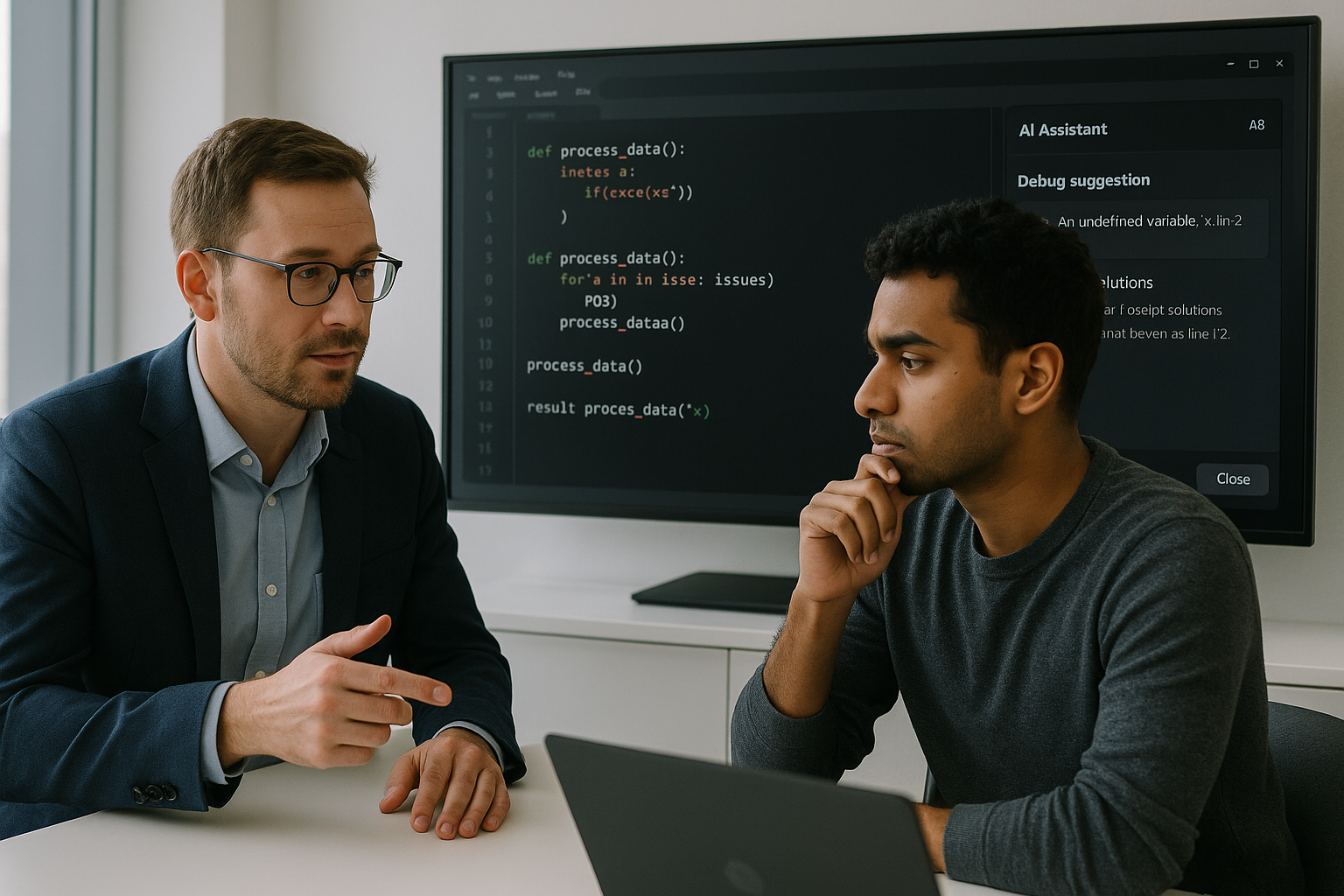
Technical interviews used to revolve around a fairly clean premise: give someone a problem, watch them write code, and use that performance as a proxy for how they will work on the job.
In 2026, that premise is harder to defend.
Most engineers now work with some level of AI assistance. They use copilots to scaffold code, chat tools to explain stack traces, and models to propose tests, refactors, or API usage. None of that is unusual anymore. The real question for hiring teams is no longer whether AI exists in the workflow. It is whether the interview process can still distinguish between fluent output and real engineering judgment.
That distinction matters because AI changes what can be produced quickly, but it does not remove the need for verification, debugging, tradeoff analysis, and accountability. A candidate can arrive at a polished answer faster than before. That still does not tell you whether they understand why it works, where it breaks, or what risks it introduces.
That is the practical challenge behind AI technical interviews in 2026. The companies that adapt their process to this reality will get better signal. The companies that do not will keep mistaking smooth answers for durable capability.
The market signal is getting harder to ignore
A lot of writing about AI and hiring falls into two bad habits: hype on one side, panic on the other. Neither is very useful.
What is useful is paying attention to how working engineers are describing the shift in real time.
In one recent thread on Reddit, developers discussed the feeling that software quality has slipped in noticeable ways, with comments pointing to rushed development, weaker review standards, and a growing tendency to accept output that looks finished before it has been truly examined (software quality discussion). In another, a developer with more than a decade of experience admitted catching themselves relying on AI too heavily while coding, which is a more revealing signal than the usual junior-versus-senior framing (AI reliance discussion).
Taken together, those conversations do not prove some grand industry collapse. They do show something more practical: engineers are feeling a shift in how code gets produced and reviewed, and hiring teams should assume that shift will show up in interviews too.
You can see the same tension in candidate-side discussions. Some developers are openly frustrated that the market feels harsher and stranger than it did for earlier cohorts, especially as expectations rise and tooling changes the nature of preparation (LeetCode discussion). Others are still working through the usual uncertainty of active interview loops and trying to understand what companies are actually screening for (interview discussion thread).
That is the backdrop for technical hiring right now: candidates are adapting, tools are changing the shape of work, and many interview loops are still acting as if nothing important has changed.
What AI changes in a technical interview
The important thing is not that candidates can use AI. The important thing is that AI makes some old signals weaker.
A fast first draft used to tell you more than it does now. Boilerplate fluency used to be a stronger differentiator. Even debugging can be partially offloaded if the candidate is allowed to ask a tool for probable fixes.
That does not mean interviews are useless. It means they need to measure different things, or at least weight them differently.
In a modern interview, employers should care about questions like these:
- Does the candidate verify code, or merely accept it?
- Can they explain why a solution works in plain language?
- Do they notice edge cases before being prompted?
- Can they identify when generated code is plausible but unsafe?
- Do they understand what to test, not just what to type?
- Can they debug a bad suggestion instead of replacing it with another bad suggestion?
Those are not soft questions. They are engineering questions. They just happen to be the ones that matter more when code generation is cheap.
The strongest candidates do not avoid AI. They use it critically.
A lot of companies are still stuck on the wrong debate: should AI be banned in interviews or allowed in interviews?
That is too simplistic to be helpful.
For some stages, especially baseline screens, it can make sense to limit tools. You may want to establish whether a candidate can reason through core programming tasks without assistance. But a blanket anti-AI posture across the entire process creates its own distortion. It tests a world that many engineers no longer work in.
The more useful distinction is between passive tool use and critical tool use.
A candidate who uses an AI assistant well should be able to:
- ask a focused question instead of a vague one
- inspect the returned code rather than trusting it
- explain what they would keep, what they would change, and why
- notice hidden assumptions
- reject suggestions that conflict with requirements
- adapt the draft to the actual constraints of the problem
That is closer to real work than the old fantasy that every strong engineer writes everything from scratch under pressure with no external support.
At the same time, companies should not overcorrect by treating polished AI-assisted output as enough. The point is not to reward tool fluency alone. The point is to see whether the candidate can remain accountable for the result.
What hiring teams should stop overvaluing
If your interview loop has not changed much in the last few years, there is a good chance it still overweights a few signals that have become less reliable.
1. First-pass coding speed
Speed still matters. But speed without inspection matters less than it used to.
A candidate who produces a neat answer quickly may simply be good at pattern recall, good at prompting, or both. That is not worthless, but it is not enough. If they cannot defend the implementation, spot flaws, or reason about tradeoffs, the fast answer is doing too much work in your evaluation.
2. Surface polish
Generated code often looks clean. Variable names are decent. Structure is plausible. Comments sound confident.
That can trick interviewers into equating readability with correctness or completeness. It is now easier than ever to produce code that looks production-ready while hiding shaky assumptions, weak error handling, or missing test coverage.
3. Puzzle performance as a complete proxy for job performance
Algorithmic rounds still have a place, especially for roles where fundamentals matter strongly. But if your entire process is basically a sequence of puzzle rounds, you are probably under-measuring the things teams complain about most after hiring: debugging quality, code review judgment, prioritization, maintainability, and communication under ambiguity.
4. Blanket suspicion or blanket trust of AI use
Both are mistakes.
Treating any AI use as cheating ignores how software is built now. Treating AI use as proof of productivity ignores how often generated code still needs careful correction. Interviews should be designed to observe the candidate's judgment, not force interviewers into ideological camps about the tool itself.
What strong AI technical interviews look like in 2026
A better interview process is not necessarily longer. It is more intentional.
The core design principle is simple: measure how candidates think when code generation is available, not just how they perform when isolated from it.
Here are a few formats that work well.
Controlled AI-assisted implementation
Instead of pretending AI does not exist, create a stage where its use is allowed and visible.
Ask the candidate to solve a scoped problem with an approved tool. Have them narrate what they ask, what they accept, what they reject, and what they test. The interviewer is not only watching for completion. They are watching for verification behavior.
Useful prompts from the interviewer might include:
- Why did you trust that suggestion?
- What would make you suspicious of this code?
- What tests would you run before merging it?
- Where might this fail in production?
This format works because it turns the interview from a secret race into an observable reasoning exercise.
Debugging-first exercises
If employers are worried about quality, they should test quality-related skills directly.
Give candidates a failing test suite, a flaky service, an inefficient query, or a pull request with a subtle defect. Ask them to trace the problem, isolate the issue, and explain the fix.
This tends to reveal far more than another generic coding challenge. It shows whether the candidate can form hypotheses, read unfamiliar code, separate signal from noise, and avoid cargo-cult fixes.
Code review and revision tasks
Much of real engineering work is not greenfield coding. It is reviewing, editing, tightening, and de-risking code written by someone else or produced through a tool.
So test that explicitly.
Give the candidate a plausible but imperfect solution and ask them to:
- point out correctness issues
- flag maintainability problems
- improve naming and structure
- identify missing tests
- call out operational or security concerns
- explain what they would change before shipping
This is especially useful because it mirrors how teams actually work.
Explanation-based scoring
A candidate who can explain a solution clearly often understands it more deeply than a candidate who only reaches the final code.
Scoring should therefore include:
- quality of reasoning n- awareness of edge cases
- ability to justify tradeoffs
- testing strategy
- willingness to revise after feedback
This is not about rewarding confidence or presentation polish. It is about checking whether the candidate can think like someone who will own the consequences of the code.
A practical framework for hiring teams
For teams updating their process this year, a balanced interview loop could look like this:
Stage 1: Baseline fundamentals
Use a short, tool-limited screen to establish core programming fluency, communication, and comfort with basic problem solving.
Stage 2: AI-assisted implementation
Allow a defined AI tool. Observe how the candidate prompts, filters suggestions, edits the draft, and validates output.
Stage 3: Debugging and quality review
Present code or a system artifact with real issues. Measure diagnosis, prioritization, and ability to improve the solution rather than merely replace it.
Stage 4: Systems and tradeoffs
Discuss architecture, maintainability, failure modes, performance, and operational concerns. This stage matters because AI can help generate code, but it does not reliably own the broader system consequences.
Stage 5: Collaborative review
Run a realistic discussion with changing requirements or interviewer feedback. This helps reveal whether the candidate can adapt, defend tradeoffs, and work through ambiguity without becoming brittle.
This kind of structure gives employers multiple ways to see the candidate. It also reduces the odds that one polished coding round dominates the entire evaluation.
Where Nuvis fits
This is where the Nuvis angle becomes concrete.
Hiring teams do not just need another way to administer coding tests. They need a better way to measure modern engineering judgment.
That means a platform should help employers evaluate things like:
- how a candidate uses AI assistance under realistic conditions
- whether they verify or merely accept generated output
- how they debug broken code
- how they explain tradeoffs and test strategy
- whether they improve software quality rather than just produce more code
That is a stronger position than simply saying AI has changed hiring. Most people in technical hiring already know that. The more valuable message is that interview signal has become noisier, and companies need a more deliberate evaluation model.
Nuvis can own that message if it stays practical.
Not anti-AI. Not AI-for-everything. Just clear-eyed about what employers are actually trying to learn: can this person use modern tools without outsourcing judgment?
That framing is better for buyers because it connects directly to the outcomes they care about. Stronger hiring signal. Fewer false positives. More confidence that a candidate can contribute in an environment where AI is available but accountability still sits with the engineer.
The bottom line
The most important shift in AI technical interviews is not that candidates now have better tools. It is that employers can no longer assume polished code equals deep understanding.
In 2026, strong technical interviews should measure verification, debugging, revision, and tradeoff thinking alongside implementation skill. They should reflect the reality of AI-assisted work without confusing tool output for engineering ability.
That is the practical standard hiring teams should be moving toward now.
And it is the right strategic opening for Nuvis: help employers run interviews that match how software is actually built, while keeping the focus where it belongs—on judgment, quality, and the ability to stand behind the code.